
By Amina Khalid & Mujahid Ameen Lilo
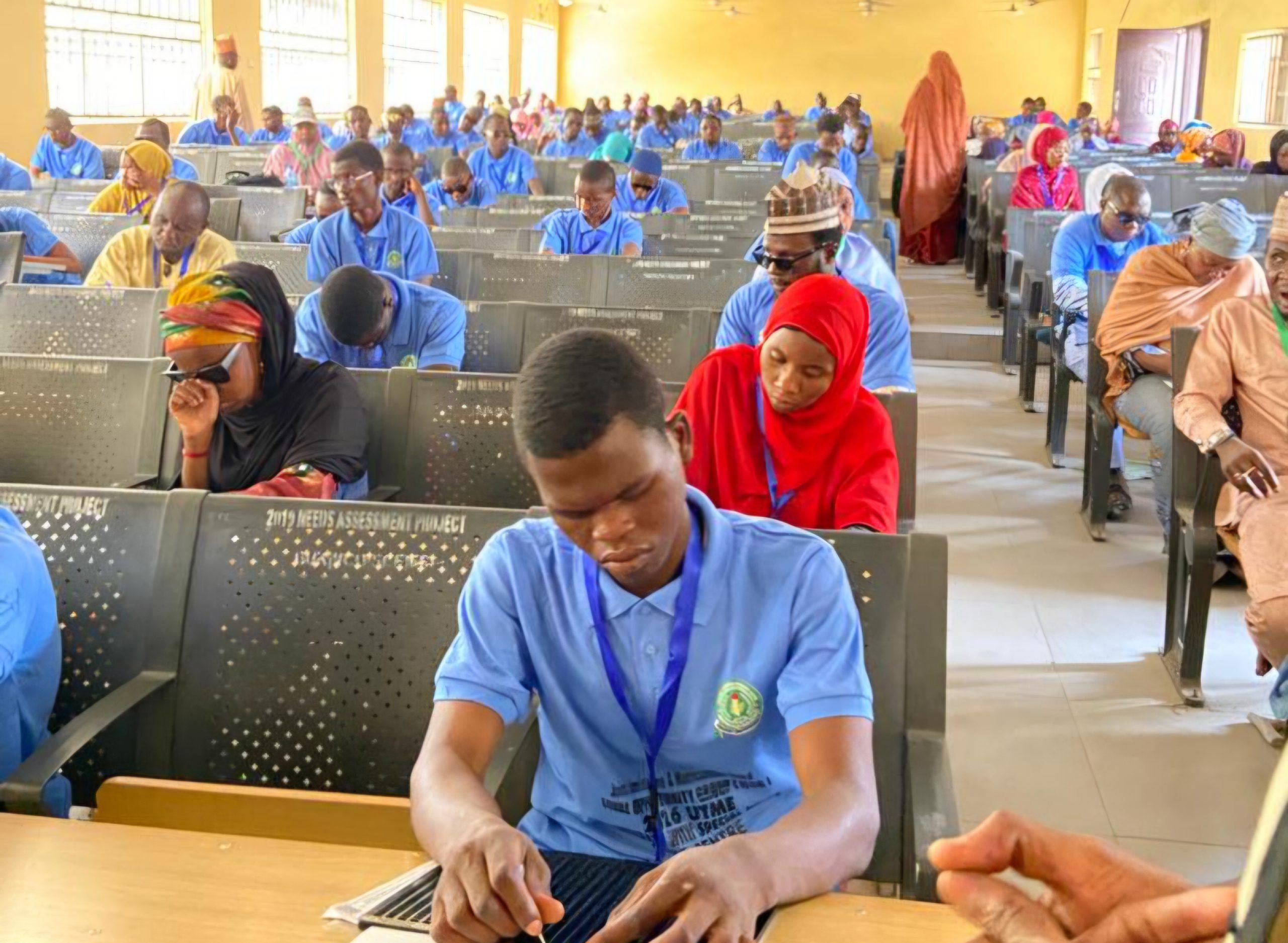
In a modest hall in Kano, a different version of Nigeria’s Unified Tertiary Matriculation Examination is taking place — one that relies not on computer screens, but on human voices.
Here, candidates do not click answers. They listen as questions and options are read aloud, then respond using slates, styluses, typewriters, or through dictation.
The examination, conducted under the Joint Admissions and Matriculation Board Equal Opportunity Group, shows efforts to include persons with visual impairments in Nigeria’s education system. However, it also highlights the slow pace of transition to fully accessible digital testing.
An alternative to computer-based tests
Across Nigeria, most candidates sit for computer-based tests. However, for visually impaired candidates, that system remains largely inaccessible.

At the Kano centre, about 135 candidates are sitting for the 2026 examination under adapted conditions. Nationwide, more than 530 candidates are being examined across 11 centres.
The Kano Centre Coordinator, Professor Muhammad Yahuza Bello, said the nature of the candidates’ disabilities makes conventional computer-based testing difficult.

“These candidates cannot effectively use the computer to read questions or input answers,” Professor Bello said. “So we read the questions aloud to them, including the options, and give them time to respond.”
He said candidates adopt different response methods depending on their abilities.

“Some use slates and styluses, others use typewriters, while those who cannot write dictate their answers to assistants assigned to them,” he added.
Candidates speak
For many candidates, the system provides an opportunity to sit for the examination under conditions suited to their needs.
Usaina Abubakar, a candidate from Dutse, Jigawa State, described the process as helpful.
“The process is very supportive. They guide us properly and give us enough time,” Mr Abubakar said. “For once, I feel like I am writing the same exam as others, not being left out.”
Another candidate, Ibrahim Hamisu from Kano, who applied to study Political Science at Bayero University Kano, said the arrangement improved his confidence.
“This arrangement has given me hope,” he said. “Without this kind of support, it would be difficult for people like us to even attempt the exam.”
He said the use of human readers makes comprehension easier.
“When they read the questions clearly, you understand better and can think through your answer,” he said.
A female candidate, who preferred not to be named, said the process reduced anxiety.
“We are not under pressure like those using computers,” she said. “Here, they make sure you understand before you answer.”
Why technology still falls short
Despite Nigeria’s shift to digital examinations, accessibility challenges remain.
Attempts to introduce Braille-based question papers have recorded limited success, as many candidates are more familiar with older Braille formats and struggle with newer adaptations.
This challenge has long been identified by stakeholders. In 2024, the Centre for Information Technology and Development (CITAD), in partnership with the Aminu Kano Centre for Democratic Research and Training, convened a stakeholders’ forum in Kano where concerns over the exclusion of persons with disabilities in computer-based examinations were raised.
In a communiqué issued after the meeting, participants highlighted that more than 80 per cent of visually impaired candidates lack basic computer skills, while accessible digital tools and infrastructure remain inadequate.
The forum urged JAMB to collaborate with technology-oriented organisations to provide training and assistive equipment for candidates with disabilities, particularly those with visual impairment. It also called for nationwide training of examination officials, provision of sign-language interpreters, deployment of assistive devices, and improved funding to support inclusive testing.
Stakeholders further stressed the need for a comprehensive national database of persons with disabilities and systematic assessment of examination centres to remove physical and environmental barriers.
However, there are indications of progress. The Centre for Information Technology and Development (CITAD), with support from the MacArthur Foundation, has established a specialised Digital Training Hub for Persons with Disabilities (PWDs), aimed at bridging the digital divide, promoting inclusion, and enhancing the employability of PWDs in Nigeria. The hub is equipped with assistive technologies, including computers, screen magnifiers, braille displays, braille keyboards, screen readers, and Perkins braillers, among others. Similarly, at Bayero University Kano, a specialised ICT laboratory fitted with tools such as screen readers and audio-enabled systems is already in use.

Mr Bello said such innovations could help improve access in the future.
“There is an application that reads whatever is on the screen,” he said. “With facilities like that, we hope that in the future these candidates can also fully participate in computer-based tests.”
Support beyond the examination hall
The board also provides accommodation, feeding and transportation stipends for candidates. In Kano, candidates are accommodated in hotels close to the examination centre.
The board refunds registration fees to eligible candidates who secure admission.
Special education experts are present to assist candidates, including those with multiple disabilities.
In one section of the hall, two candidates with both visual and partial hearing impairments were assisted by a specialist who repeated questions slowly to aid understanding.
Exceptional performance
Despite the constraints, some candidates record high scores.
Without the option of rough work, especially in subjects like Mathematics, some rely on mental calculations.
Mr Bello said their performance is notable.
“That some of them score as high as 280 is remarkable,” he said. “It shows their determination and capability.”
Admission policies: progress and gaps
Some institutions, including Bayero University Kano, have introduced measures such as exempting visually impaired candidates from post-UTME screening and adjusting admission cut-off marks.
They also provide accessible learning facilities, including specialised libraries and assistive technologies.
However, these measures are not implemented across all universities.
In some cases, candidates who perform well in the examination are unable to secure admission due to the absence of accessible post-UTME arrangements.
Life after school
While access to education is improving, employment opportunities for persons with disabilities remain limited.
Mr Bello cited the example of a deaf university graduate working as a labourer.
“One way to encourage education among persons with disabilities is to support them after graduation,” he said. “There must be deliberate policies to ensure their inclusion in employment.”
He said although Nigeria has a policy mandating a minimum five per cent employment quota for persons with disabilities, implementation remains weak.
A system evolving
Candidates and their families described the initiative as significant.
For many, it is the first time the education system has been adjusted to meet their needs.
However, the exercise reflects a broader issue: inclusion in Nigeria’s education system is improving, but remains incomplete.
As earlier advocated by CITAD and other stakeholders, bridging this gap will require sustained collaboration, investment in assistive technologies, and deliberate efforts to equip persons with disabilities with the digital skills needed to fully participate in Nigeria’s evolving computer-based examination system.