
By Buhari Abba
A nomadic primary school serving Kondawa, Digawa, Yangamai Ayas, Kundi, Dolede, Talba and Gundumi communities in Jama’are Local Government Area of Bauchi State has fallen into disrepair, forcing many pupils to abandon classes for grazing and farming activities.

The school, established about eight years ago by the National Commission for Nomadic Education (NCNE), was designed to serve more than 100 pupils across the Fulani settlements. However, it is now largely non-functional, with only one teacher managing the entire school.

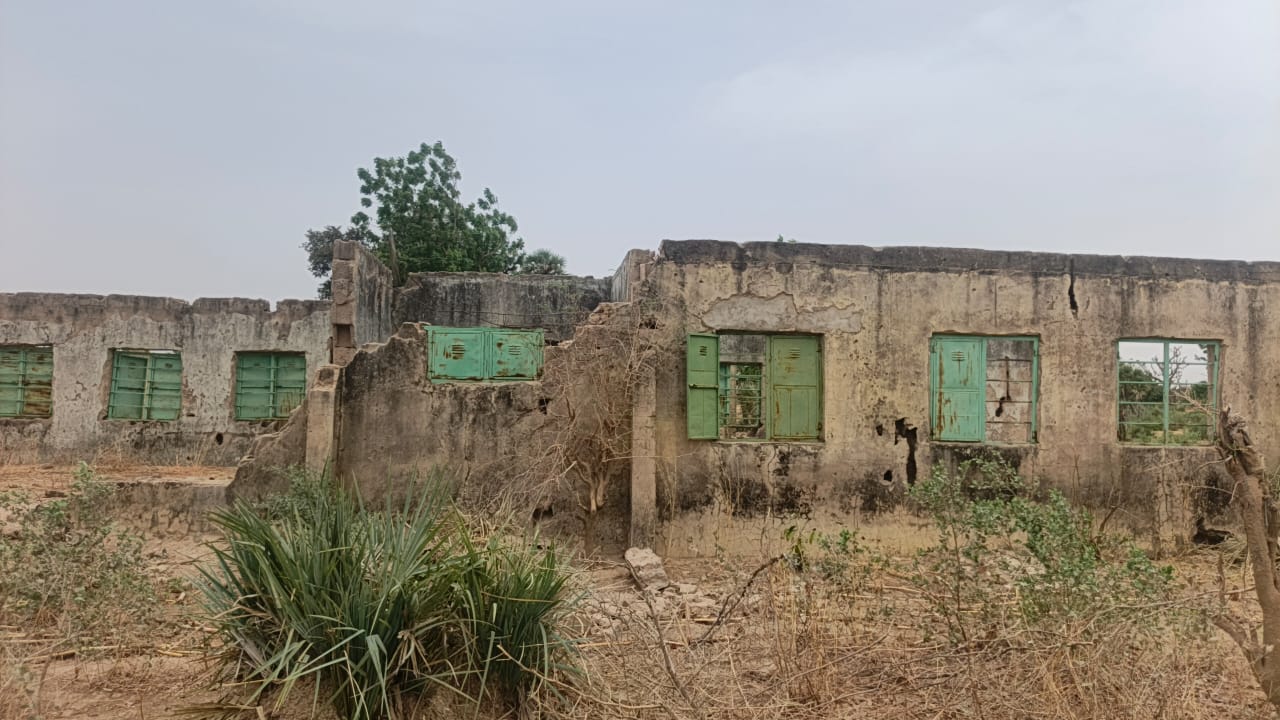
Findings by CITAD Radio revealed that the school’s infrastructure has deteriorated badly, with collapsed walls, missing roofs, vandalised classrooms and overgrown surroundings making the environment unsafe for learning.

Parents in the affected communities said the poor condition of the school and lack of teachers have forced them to withdraw their children.
Malam Idris Muhammad, a resident of Digawa, said he had no option but to take his children out of school.
“All my three children and those of my brothers are now at home. There is no proper teaching anymore. Instead of going to school, they now assist us in grazing,” he said.

Another resident, Malam Ya’u Kwandawa, said the situation has disrupted education across the communities.
“Our children from places like Yangamai Ayas, Kundi and Dolede used to attend the school when it was manageable. Now there are no teachers and no proper classrooms. We cannot keep sending them there when nothing is happening,” he said.
He added that most children now join their parents in grazing and farming to support their families.
Adamu Bodo Kwandawa also said the situation has forced many families, including those from Talba and Gundumi, to abandon formal education.
“I have two children who should be in school, but because of the condition of the school, they now go with me to the farm and take care of livestock. We know education is important, but survival comes first,” he said.
He noted that parents would be willing to return their children to school if the facility is rehabilitated and more teachers are deployed.
The headmaster of the school, Malam Yakubu, said the situation has made effective teaching difficult.
“I have been here for over two years, and I am the only teacher handling more than 60 pupils from different communities. I have written several times requesting more teachers, but nothing has been done,” he said.
He disclosed that the school has six class registers, one for each grade, with about 25 pupils recorded in each class. However, attendance is low as many children no longer come to school regularly.

According to him, even those who complete primary education rarely proceed to secondary school.
“Most of the boys are taken by their parents for grazing and farming, while many of the girls are married off at a young age,” he said.
Yakubu, who travels about 10 kilometres daily from Jama’are, said the workload and poor condition of the school have made teaching almost impossible.
A visit to the school showed that several classrooms are in ruins, with broken floors, stagnant water and weeds taking over the premises. Residents said reptiles, including snakes, are often sighted in the abandoned structures.
A community leader, Jauro Abubakar Buba, attributed the situation to years of neglect.
“Education is important to us, but one teacher cannot handle a school like this, especially one serving many settlements. The environment is not conducive for learning,” he said.
Nigeria has one of the highest numbers of out-of-school children in the world, particularly in rural and nomadic communities.
The NCNE, established in 1989 to provide education for pastoralists and migrant communities, oversees over 4,000 nomadic schools across the country. However, many of these schools are either non-functional or operating under poor conditions.
Experts say nomadic education requires sustained investment of over N15 billion annually for at least a decade. However, only N3.59 billion was proposed for the NCNE in the 2026 Appropriation Bill.
Of this amount, N2.67 billion is earmarked for capital projects, while less than N1 billion is for personnel and overhead costs, including N604 million for salaries and about N202 million for operations.
Residents of the affected communities said they are willing to send their children back to school if urgent action is taken.
“If there are teachers and a functional school, we will send our children,” Malam Idris said.
Malam Ya’u Kwandawa also called on the government to intervene.
“We want our children to go to school, but the authorities need to make the school functional again,” he said.
Efforts to get a response from the Executive Secretary of the Bauchi State Agency for Nomadic Education (BASANE), Alhaji Ahmad Abdullahi Bello, were unsuccessful.
For now, the school remains largely deserted as children from Kondawa, Digawa, Yangamai Ayas, Kundi, Dolede, Talba and Gundumi continue to accompany their parents to grazing fields instead of attending classes.