
By Sadiya Ahmad Musa
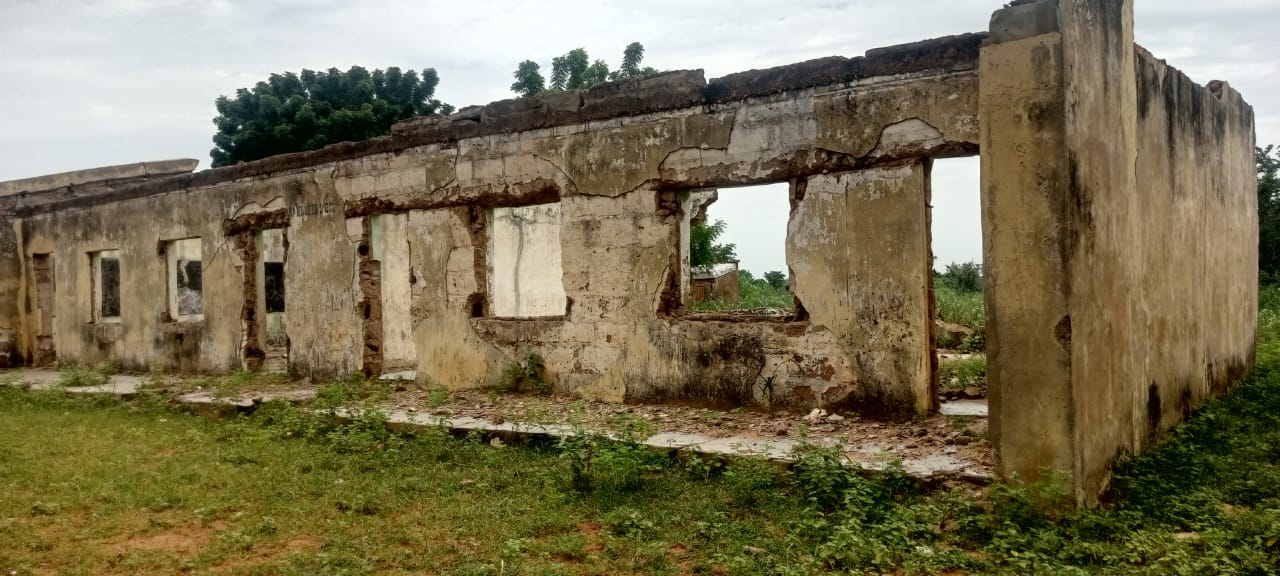
On a windy day in Yammawa, a rural community in Dambatta Local Government Area of Kano State, hundreds of children gather for lessons in a school whose only major classroom block is showing signs of age.
The roof has been battered by strong winds. Desks and chairs are inadequate. The community has repeatedly appealed to authorities for help, but the promised intervention has yet to come.

For about 300 pupils from seven Fulani communities, however, the dilapidated facility is more than a school. It is their main gateway to formal education.
“We have about 300 pupils, and seven Fulani communities depend on this school for the education of their children,” said Abdulsam Ibrahim, the Head Teacher of Yammawa Nomadic Primary School.
The situation at Yammawa is replicated in several nomadic settlements across Northern Nigeria, where schools created to take education to mobile and marginalised communities are struggling with inadequate classrooms, teachers, furniture and learning materials.
The neglect comes at a time when the North is facing one of its worst security crises in decades, with bandits attacking villages, killing residents, destroying farmlands and abducting people for ransom.
While governments have largely responded to the crisis through military operations, intelligence gathering and deployment of security personnel, experts say the roots of the problem may extend beyond the battlefield.
They point to poverty, exclusion, lack of education and the absence of basic services in rural and nomadic communities as part of the issues that require attention.
A programme created for the excluded
The National Commission for Nomadic Education (NCNE) was established in 1989 by the military government of General Ibrahim Badamasi Babangida.
It was created through Decree No. 41 of December 12, 1989, to address the educational needs of socially excluded and educationally disadvantaged groups, particularly nomadic pastoralists, migrant fisher-folks and migrant farmers.
The decree is now known as Act Cap N20 of the Laws of the Federation of Nigeria (LFN) 2004.
Statistics show that more than 10 million Nigerians fall within these categories, while more than 4,000 schools have been established across the country to cater to communities whose migratory lifestyles make conventional schooling difficult.
But more than three decades after the commission was established, the system is facing serious challenges.
Across Northern Nigeria, many nomadic schools have become moribund, with stakeholders blaming inadequate funding, poor infrastructure and shortage of teachers and learning materials.
The result is an education system that is struggling to reach some of the children most in need of it.
When nomadic education flourished
Education stakeholders describe the administration of former President Goodluck Jonathan as the period when nomadic education received one of its strongest interventions.
His administration built more than 100 standard nomadic education schools across the country and established radio stations to broadcast educational programmes in local languages to migrant communities.
The administration also pursued the integration of Western education with traditional Quranic education through the Almajiri Integrated Model Schools Programme.
The initiative was intended to bring children who were traditionally excluded from formal schooling into the mainstream education system while recognising their existing Quranic education.
Stakeholders say the intervention reached different parts of the country.
But after the period of increased investment, the sector again suffered neglect.
A school waiting for help
At Yammawa Nomadic Primary School, the problem is immediate.
The school was established in 1976 but, according to its head teacher, has received only one major infrastructural intervention since then.
Mr Ibrahim said the school received a block of classrooms in 2010 during the tenure of the then Dambatta Local Government Chairman, Gambo Diggol.

That block remains the school’s principal facility.
Strong winds have damaged parts of the structure, while the shortage of desks and chairs has made teaching and learning more difficult.
The pupils come from Jedi, Halo, Jedawa I, Jedawa II, Unguwar Wakili, Unguwar Ciroma and Kurci.
The school management has already informed relevant education authorities and the local government about the situation.
But Mr Ibrahim said the school was still waiting for assistance.
If government intervention does not come, he said, the school may have to turn to parents and community members for emergency repairs.
“We may have to meet with the parents and see what we can do to repair the roof so that learning can continue because these children need education,” he said.
‘We could no longer continue’
The community says it has not remained silent.
Sa’idu Yammawa, Chairman of the School-Based Management Committee, said residents had repeatedly drawn the attention of government authorities to the condition of the school.
According to him, the committee submitted two written requests through the councillor, asking for assistance and requesting that the matter be forwarded to the Dambatta Local Government Chairman.
Community representatives also followed up through local structures.
At one point, residents secured a temporary shelter for the pupils, but strong winds destroyed it.
With little external assistance, community members formed a committee and began collecting money from parents whenever urgent repairs were required.
But poverty eventually made the arrangement unsustainable.
“We came together and started collecting contributions from the parents so that whenever there was a problem, we could use the money to address it. But later, we could no longer continue because of the financial burden,” Mr Yammawa said.
The community now wants government to rehabilitate the existing classrooms and build additional ones.
It also wants more qualified teachers, desks, chairs and learning materials.
But there is another major gap: there is no secondary school section to accommodate children after they complete primary education.
“We are appealing to the government. We understand that Governor Abba Kabir Yusuf is making efforts in the education sector, and we are asking that our Fulani children should not be forgotten,” Mr Yammawa said.
The problem is bigger than Yammawa
Yammawa is not an isolated case.
In Hurgu Fulani village in Rogo Local Government Area of Kano State, a nomadic school operates from a single block of classrooms serving more than 100 pupils, with enrolment fluctuating according to the season.
Only two teachers are assigned to the school.
Hardo Yahaya, leader of the Hurgu Fulani community, said the teachers were doing their best but were insufficient for the number of pupils.
“The two teachers are not enough, though they have been doing quite a great job in educating the community members,” he said.
Mr Yahaya said more teachers were needed if the school was to continue providing meaningful education to the community.
From Islamiyya to primary school
In Muntutre, another predominantly Fulani community in Kano State, residents have taken a different approach.

The school, established by former Kano State Governor Rabiu Musa Kwankwaso, is now supported by the Rano Local Education Authority, which posts teachers to the institution.
More than 70 per cent of the pupils are Fulani.

For residents, the school has transformed the community.
Before its establishment, the settlement had no formal school.
Ubale Bashari, a spokesperson for the parents, said the institution initially started as an Islamiyya before developing into a primary school.
“The school started off as an Islamiyya and later the Primary School took off. The exciting thing about the whole gesture was when parents indicated interest to seek knowledge too,” Mr Bashari said.
The development, he said, showed that demand for education extended beyond children.
Where is the money?
Beyond the deteriorating classrooms and inadequate manpower lies another fundamental question: how much is being spent on nomadic education?
Jibril Muhammad Shehu, a Kano-based educationist, said funding for nomadic education in the state was not clearly defined.
He said allocations were embedded within the general education budget rather than provided under a separate budgetary vote.
He cited the 2024 and 2025 budgets as examples.
The absence of a clearly defined allocation, he argued, makes it difficult to determine how much government is investing in schools serving nomadic communities and whether the resources are sufficient to meet their peculiar needs.
The security question
The education crisis is unfolding against the backdrop of a worsening security situation.
Bandits have continued to attack communities across the North-west and North-central regions, killing residents, destroying farms, sacking villages and abducting people for ransom.
The response has largely centred on military operations and other security measures.
But the former Executive Secretary of the NCNE, Professor Bashir Usman, believes education must form part of the response.
Speaking at a four-day workshop on a new curriculum for nomadic education, Professor Usman said vibrant nomadic education could prevent young people from relapsing into conflicts, insurgency, armed robbery, kidnapping, drug abuse and rape.
“Our country is therefore in dire need of a solution to stem the rising spate of this menace that is at the roots of our current national security challenges with all its attendant consequences,” he said.
His argument is that education can provide young people with alternatives to violence and criminality while strengthening their connection to the wider society.
But other experts caution against presenting education as a stand-alone solution to banditry.
‘If you missed education, you missed everything’
Yahya T. Baba, a professor of Political Science at Usmanu Danfodiyo University, Sokoto, links the insecurity to years of government neglect of nomadic communities.
According to him, Fulani communities have lost grazing reserves, livestock and other means of livelihood, while what they perceive as injustice has increased their sense of exclusion.
He said some were consequently forced to seek alternative ways of survival and protection.
“All these are the consequences of a long time neglect of nomadic education. Because if you missed education, you missed everything,” Professor Baba said.
His argument suggests that the education crisis should not be viewed separately from the broader socioeconomic crisis affecting pastoral communities.
‘Education alone is not the answer’
Ibrahim Adamu Abubakar, a lecturer in the Department of Economic and Development Studies at the Federal University, Dutse, takes a more cautious position.
He agrees that education is important but says it cannot, by itself, resolve the complex problem of banditry.
He noted that even educated people in urban areas are not necessarily gainfully employed.
“Educating them alone is not the answer to the banditry puzzle, because the Fulani herdsmen issue is a multi-faced that needs a multi-dimensional approach to it,” Mr Abubakar said.
He also argued that the government needed to establish the number and status of Nigerian Fulani, alleging that many herders operating in the country were foreigners.
“There should be a total overhauling of the whole herdsmen concept through provision of basic infrastructure facilities as well as provision of a well-defined grazing route for their cattle,” he said.
For Mr Abubakar, the solution requires more than classrooms.
It requires infrastructure, economic opportunities, livestock development, clearly defined grazing routes and a comprehensive policy for pastoral communities.
A crisis hiding in plain sight
The condition of nomadic schools raises a difficult question for Nigeria’s security strategy.
If millions of children remain excluded from quality education, and schools designed specifically for their communities are allowed to deteriorate, what are the long-term consequences?
At Yammawa, the answer is visible in a classroom block struggling against the elements.
At Hurgu Fulani, two teachers are expected to educate more than 100 pupils.
At Muntutre, a community that once had no formal school is relying on an institution that residents consider a major achievement.
These communities are not asking for sophisticated educational facilities.
They are asking for classrooms that will not collapse, teachers who are sufficient for the pupils, desks and chairs, learning materials and opportunities for their children to continue beyond primary school.
What happens next?
The communities are appealing to the Kano State Government, education authorities, Dambatta Local Government Council, traditional institutions, development partners and other stakeholders to intervene.
They want Yammawa Nomadic Primary School rehabilitated, more classrooms constructed, teachers deployed and basic learning materials provided.
They also want a secondary school established so that children do not have to end their education after primary school.
For the approximately 300 pupils currently enrolled at Yammawa, the stakes are immediate.
If the deteriorating classroom block is not repaired, learning could become even more difficult.
But the implications extend beyond one school.
Nigeria established the NCNE more than three decades ago because conventional education was failing to reach nomadic and migrant populations.
More than 10 million Nigerians are estimated to fall within the communities the programme was designed to serve, while thousands of schools have been established for them.
Yet, decades later, many of those schools remain poorly equipped.
The lesson from the North’s security crisis may therefore be that the absence of classrooms can eventually become more than an education problem.
It can become a development problem, an economic problem and, potentially, a security problem.
Military force may suppress an armed group.
But if the conditions that leave communities excluded from education, livelihoods and basic public services remain unresolved, experts warn that new forms of insecurity can continue to emerge.
For the children sitting in the ageing classrooms of Yammawa, the demand is simpler: they want the opportunity to learn.
Whether government responds before the school deteriorates further may determine more than their immediate educational future.
It may also test Nigeria’s willingness to address one of the less visible dimensions of the insecurity crisis in the North.