
Buhari Abba
Labour leaders, civil society organisations and economic experts have called on the Nigerian government to abandon the market-driven economic model introduced under the Structural Adjustment Programme (SAP) and adopt a developmental state approach focused on industrialisation, job creation and social welfare.
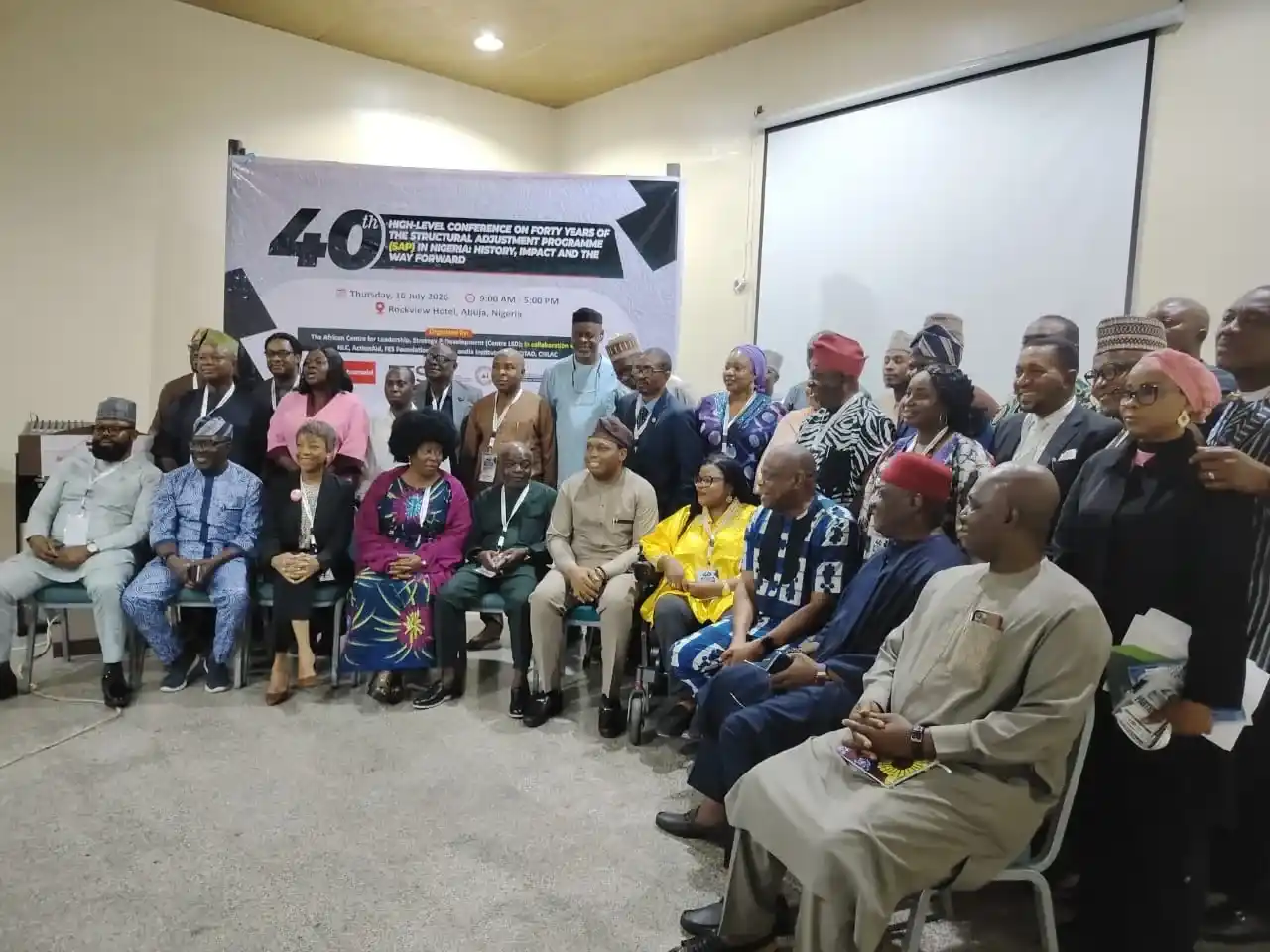
The call was made at a national conference in Abuja titled, “Forty Years of Structural Adjustment Programme in Nigeria: History, Impact and the Way Forward,” organised by the African Centre for Leadership, Strategy and Development (Centre LSD) in collaboration with ActionAid Nigeria, the Centre for Information Technology and Development (CITAD), the Nigeria Labour Congress (NLC), the Centre for Democracy and Development (CDD), Friedrich Ebert Foundation, CISLAC, SDA and the Amandla Institute.
Participants said four decades after Nigeria adopted the International Monetary Fund (IMF) and World Bank-backed reforms in 1986, the country continues to struggle with unemployment, poverty, weak industrial growth and overdependence on crude oil exports despite years of liberalisation, privatisation and deregulation.
In his opening remarks, the founder of Centre LSD, Otive Igbuzor, said the country’s current economic policies bear strong similarities to the SAP reforms introduced in 1986.
“Whether one regards SAP as a necessary response to an economic crisis or as the beginning of many of our developmental challenges, there is no doubt that it fundamentally altered the direction of Nigeria’s economy and society,” Mr Igbuzor said.
He urged policymakers to prioritise the welfare of citizens in evaluating economic reforms.
“Economic reforms should be measured by their ability to create jobs, reduce poverty, strengthen institutions, improve education and healthcare, deepen industrialisation and restore hope,” he added.
Delivering the keynote address on behalf of political economist Adebayo Olukoshi, Egghead Odewale, Director of Operations at AIPCTA, said current debates over the floating of the naira, fuel subsidy removal and debt sustainability are rooted in the philosophy behind SAP.
Human rights activist Ayo Obe also linked the Tinubu administration’s reforms to the 1986 policy.
“The floating of the naira and fuel subsidy removal are core principles of SAP. President Tinubu’s reforms are another attempt to see whether Nigeria can implement SAP and get it right,” she said.
Ms Obe argued that countries such as the United States, Japan, China, Singapore and Rwanda achieved economic transformation through deliberate government intervention rather than relying solely on market forces.
Representing the Country Director of ActionAid Nigeria, the organisation’s Head of Programmes and Policy, Celestine Odo, described SAP as an austerity programme that weakened social protection and worsened poverty.
“The economy may be growing on paper, but poverty and inequality are rising. That kind of growth has no human face,” Mr Odo said.
He added: “No serious country abandons its citizens to the market. Governments in Europe, America and Scandinavia spend heavily on social protection because governance is about service, not profit.”
The Director of the Centre for Democracy and Development (CDD), Dauda Garuba, said governments should not apply market principles to governance.
“Markets are driven by profit, while governance is driven by service. Government cannot be run with the ethics of the market,” Mr Garuba said.
“If you discover that you are on the wrong road, no matter how far you have travelled, the right thing is to retrace your steps.”
Although participants acknowledged that SAP encouraged private investment in sectors such as telecommunications, they said it failed to diversify the economy, modernise agriculture and strengthen domestic manufacturing.
In a communiqué issued after the conference, stakeholders called for a new economic framework anchored on increased public investment in infrastructure, technology-driven agriculture, education, healthcare and social protection.
They also urged the government to leverage the African Continental Free Trade Area (AfCFTA) to boost local manufacturing and accelerate economic diversification.