
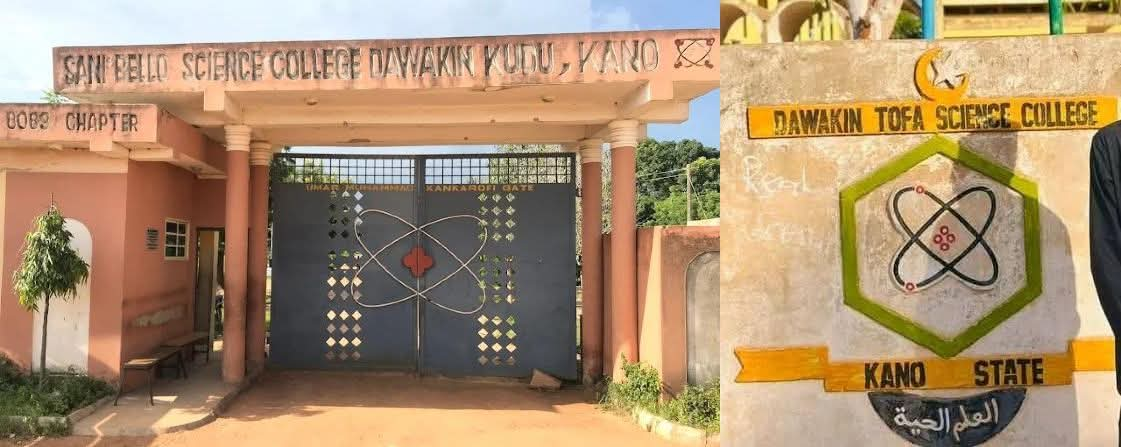
Nearly five decades after it was established as one of Nigeria’s pioneering specialised science secondary schools to produce future doctors, engineers and scientists, Government Science College, Dawakin Tofa, Kano State, is grappling with severe infrastructural decay, acute teacher shortages and poor learning conditions, a CITAD Radio investigation has found.

The school, founded in April 1977 by the then Military Governor of Kano State, Col. Sani Bello, was conceived under what became known as the “Dawaki Experiment”—an ambitious initiative aimed at accelerating the production of highly skilled science professionals for Nigeria.
It commenced academic activities in September 1977 with 120 students admitted strictly on merit through competitive entrance examinations conducted by the West African Examinations Council (WAEC).
For decades, the institution earned national recognition for academic excellence, attracting expatriate teachers and some of Nigeria’s most qualified science educators.
However, findings by CITAD Radio show that the college has fallen into a state of neglect, raising concerns about the future of science education in Kano State.

Students without Computer Studies teacher
One of the most pressing challenges at Government Science College, Dawakin Tofa, is the prolonged absence of a Computer Studies teacher.
Staff members who spoke to CITAD Radio on condition of anonymity said students have gone about 16 months without receiving lessons in the subject despite its growing importance in modern education.
“The students have not had a Computer Studies teacher for over a year. This has seriously affected their learning because the subject is now fundamental in today’s digital world,” one staff member said.
The teacher shortage extends beyond Computer Studies.
During a recent visit by CITAD Radio, SS3 students were writing their Senior Secondary Certificate Examination (SSCE), while more than 10 classrooms occupied by SS1 and SS2 students were left without teachers to supervise lessons.
According to another staff member, such scenes have become routine.
“This is not something that happened only on that day. It has become the normal situation here. Several classrooms remain without teachers because there are simply not enough staff to handle the workload,” the source said.
Infrastructure in disrepair
The investigation also found widespread deterioration of school facilities.
Hostel buildings have leaking roofs, cracked walls, broken windows and weakened structures that expose students to harsh weather conditions.

Many of the toilets are damaged and inadequate for the growing student population, while classrooms lack sufficient desks and chairs, forcing some students to sit on the floor during lessons.

Access to clean water has also become a major challenge, with students reportedly struggling to obtain water for drinking, bathing and other daily needs.
A staff member described the conditions as increasingly difficult for both students and teachers.
“The learning environment has deteriorated significantly. Basic facilities that should support teaching and learning are no longer functioning as they should,” the source said.

Alumni support not enough
Although the school’s alumni association and former students have continued to execute intervention projects, staff say the scale of deterioration has overwhelmed their efforts.
“Old students have been supporting the school over the years through different projects, but the problems are far beyond what alumni alone can solve,” another staff member told CITAD Radio on condition of anonymity.

“The level of decay requires comprehensive government intervention. Without that, the school will continue to decline.”
Concerns over science education
Speaking to CITAD Radio, Malam Sani Bello Tukur, an education stakeholder, said the deteriorating condition of Government Science College, Dawakin Tofa, threatens the original vision behind the establishment of the specialised science school.

He said the college was created to produce highly skilled professionals in science, engineering and medicine, but warned that the current state of infrastructure and the shortage of qualified teachers were undermining that objective.
“If we allow institutions like Government Science College, Dawakin Tofa, to continue deteriorating, we are jeopardising the future of science education in Kano State and Nigeria. These schools were established to nurture some of the country’s brightest students, and they deserve the necessary support to fulfil that mandate,” he said.

Malam Tukur called on the Kano State Government to urgently recruit qualified science teachers, rehabilitate classrooms and hostels, provide functional water and sanitation facilities, equip laboratories and improve access to modern learning materials.
“Government must act now. Revitalising this school is not just about renovating buildings; it is about investing in the future of our children and preserving the vision behind the historic Dawaki Experiment,” he added.
He stressed that restoring Government Science College, Dawakin Tofa, would help revive its reputation for academic excellence and strengthen science education for future generations.