
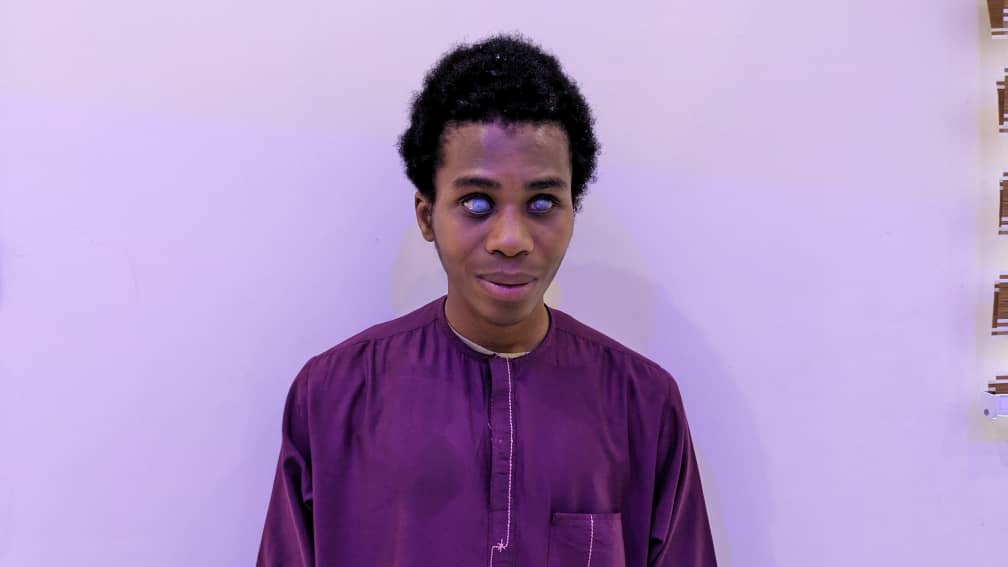
In Sharada, a densely populated area of Kano Municipal, residents often gather—not for ceremonies or events—but to listen to the unique talent of a blind teenager who can mimic characters from Indian-Hausa movies with striking precision.
Ahmad Aminu Sufi, 19, lost his sight to glaucoma at the age of nine. Since then, he has developed the ability to replicate multiple voices commonly heard in Bollywood and Telugu films dubbed in Hausa.
“After I became blind, I began to focus more on sounds,” he told CITAD Radio. “I grew up watching Indian-Hausa films with my siblings, and when my vision faded, I paid close attention to the voices. That’s where it all began.”
Indian-Hausa films, typically dubbed by studios such as Algaita Dub Studio, are widely watched in northern Nigeria. For Ahmad, these films became more than entertainment—they became an informal learning ground.
“I can mimic more than ten different voices,” he said. “Men, women, old people, young ones. Once I hear a voice, I can reproduce it. I even mimic the dramatic sound effects in the films.”
Ahmad also taught himself basic Hindi through regular listening. A Hindi-language programme aired on a private FM radio station in Kano became a learning tool.
“I don’t have access to textbooks in Braille, so I learn by listening, repeating, and recording myself,” he said.
He recently completed his studies at the Special Education School in Tudun Maliki and sat for the 2025 Unified Tertiary Matriculation Examination (UTME). He has applied to study Mass Communication at Bayero University, Kano.
“My ambition is to become a journalist and work in broadcasting,” he said. “I want to tell the stories of people with disabilities—people whose voices are often ignored.”
Despite his determination, Ahmad faces obstacles, especially the lack of assistive learning devices. He depends on borrowed tools and assistance from his younger siblings to study.
“I wish I had a screen reader, a digital voice recorder, a smartphone, even a typewriter. These tools would help me learn better,” he said.
Locally known as “India Boy,” Ahmad draws the attention of children and adults alike, who stop to listen as he switches effortlessly between voices. One of his most talked-about performances is a reenactment of a scene from Baazigar, where he mimics both Shah Rukh Khan’s character and the mother figure in the film.
“When people laugh or clap after I perform, I feel like I’m doing something valuable. I may not see, but I hear and feel everything,” he said.
His story brings to light the broader issues surrounding disability in the region. Many visually impaired individuals are left without support, often ending up on the streets or excluded from education and skills development.
“We can learn, we can create, we can inspire,” Ahmad said. “All we need is support and encouragement.”
A family member who spoke to CITAD Radio described Ahmad’s persistence as unusual. “Even after losing his sight, he kept pushing himself. He kept listening and talking. Now he can do what many never expected,” the relative said.
Ahmad is seeking support from individuals, organisations, and institutions that can assist him in acquiring the tools necessary to pursue his education and refine his talent.
“I just need the right tools. With God’s help, I believe I will make it,” he said.
As Indian-Hausa films continue to resonate with audiences in northern Nigeria, Ahmad Aminu Sufi hopes to evolve from an imitator to a creator—perhaps one day lending his own voice to the films that shaped his childhood.
“I believe disability is not inability,” he said. “If you can hear my voice, then I’m already halfway to my dream.”