
By Salim Sani Shehu
Camera: Salim Sani Shu
The town of Bulangu, located in Kafin Hausa Local Government Area of Jigawa State, Nigeria, was once a thriving community with a bustling market that attracted traders from across northern states. With a population of approximately 10,000, Bulangu was known for its vibrant farming and trading activities, which played a significant role in the local economy and the wider Jigawa State.

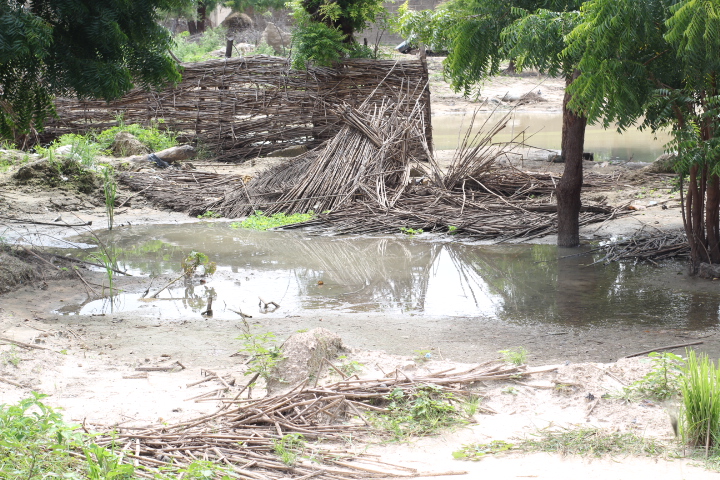
However, in August this year, the town was devastated by a catastrophic flood, severely impacting its livelihood and economy.
“Historically, Bulangu had been susceptible to seasonal rains, but flooding of this magnitude was unprecedented” stated by Mallam Haruna Waziri, Wazirin Wamban Bulangu.

“In recent years, environmental factors, such as deforestation, poor drainage system, and authorities reluctant to address the issue have increased the risk of severe flooding in the area”. Said Abdullahi Idris Bulangu, an active member of the Bulangu Development Association. He continued to mention that “While smaller floods had been recorded in the past, this year’s event was unparalleled in its scale and devastation”
The flood which occurred on 1st, 13th and 19th August, was triggered by a combination of heavy rainfall, storms, etc. Despite indications such as the town’s aging infrastructure, including its drainage systems no action was taken to avert the disaster by the authority in the state. The town’s water reservoir which is under construction failed to withstand the immense pressure of the rising waters, resulting in severe damage to the community.
Within hours of the rain, homes, businesses, and farms were submerged, leaving thousands of residents displaced, more than 300 houses destroyed, and many more facing the loss of their livelihoods. “The government’s response, though immediate, lacks the resources and preparation to mitigate the disaster’s impact”. Said Salamatu Muhammad who is living with her seven children in the Bulangu Boarding Primary School as IDP.

“Our town had been virtually destroyed, with many structures beyond repair. People are just living in agony, and many don’t know where their next meal will come from”. Said Zuwaira Muhammad, an elderly woman also living in the IDP.

Victims Recount their Agony
For the residents of Bulangu, the flood has left lasting scars, both physical and emotional. In the aftermath, victims, community leaders, and youth groups shared their stories.
Speaking from the primary school that now serves as a shelter. Salamatu Muhammad recounted “I’ve lived here my whole life. Watching everything I’ve built wash away in a matter of hours, it’s something I’ll never forget”. She continued to mention that “We didn’t have time to save anything. The water came so fast. All we could do was run. I have five farms, but they are all destroyed by the flood including our house.”
Muhammad Adamu, a farmer in the community narrated that: “It’s not just the buildings; it’s my livelihood, my farms and everything I’ve worked for. Now, it’s all gone. The water didn’t just take my house, it took my sense of security-my farms.”

COMMUNITY LEADERS’ RESPONSE
Community leaders in Bulangu have been at the forefront of coordinating relief efforts and advocating for more support from individuals, organizations, NGOs and governments. Abdullahi Idris Bulangu of the Bulangu Development Association expressed frustration with the government’s response.

“We weren’t prepared for a disaster of this scale. The warnings came, but our infrastructure simply wasn’t ready. We need better planning and support to prevent this from happening again.” Abdullahi continued to state that the water reservoir which is under construction was meant to prevent situation like this, but he faulted the way the construction is being handled. Part of the complaints by the community members was the lack of community involvement, the quality of the work etc.
Community Groups’ Initiatives
Community groups like Bulangu District Consultative Forum have been making frantic efforts to raise fund, food items, medicines and other supplies to support displaced families. “It’s been painful seeing our town like this,” said Mr Shehu, Vice Chairman of the Forum.

“But we couldn’t just stand by. We knew we had to take action. We’ve been collecting supplies, raising money from both individuals and organizations.” He added
Speaking on behalf of the district head, Wazirin Wamban Bulangu and Hakimin Bulangu, Mallam Haruna Waziri acknowledged the scale of the disaster and the challenges it posed to the community.
“This flood was unprecedented in our district’s history. We are deeply saddened by the loss and destruction it has caused,” said Waziri Haruna “Our priority now is to ensure that relief reaches every household, and we are working closely with both local and states officials to mobilize resources to support the victims.”
GOVERNMENT EFFORTS
To address the situation and bring relief to the victims, the Jigawa State Government approved N1.06 billion for the State Emergency Management Agency (SEMA) to procure relief items for flood victims. This funding will support the 14,148 displaced individuals currently residing in 53 Internally Displaced Persons (IDP) camps across the state.

However, many Bulangu residents believe the disaster could have been minimized with better preventive measures. “We’ve expressed our concerns to the authorities for years,” said Abdullahi Idris Bulangu. “They promised improvements, but the efforts weren’t enough. Now, we’re paying the price.”
For years, community leaders and youth groups like the Bulangu Development Association had warned of the increasing risk of flooding in the area, yet little action was taken to strengthen infrastructure or implement effective disaster response plans.

“I’ve lived here for decades, and every rainy season, we’ve expressed our concerns to the authorities,” said Abdullahi Idris Bulangu. “They promised improvements to our drainage systems and flood defenses, but the efforts we see are not enough. Now, we’re paying the price.”Community members have criticized the way authorities are handling relief materials. “we were left to fend for ourselves, while our businesses and farms were washed away, and we couldn’t even get food to eat” Said Tabawa Umaru, a resident of the community now living with her children at the Bulangu Boarding Primary School.

Ahmed Ilallah, Jigawa State Lead for Green and Environmental Project Initiative (GEPI), explained efforts by civil society organizations to engage relevant agencies and sensitize communities on flood prevention. “We’ve engaged with the Ministry of Environment, the House of Assembly, and other agencies to prevent flooding,” Ilallah said.

Comrade Musbahu Muhammad Basirka, President of the African Network for Anti-Corruption (ANA), emphasized that ANA has worked with stakeholders to develop early warning systems and flood prevention plans, adding that the organization will continue to monitor the situation closely.

Attempts to reach Dr. Haruna Mairiga, the Executive Secretary of the Jigawa State Emergency Management Agency (SEMA), for comments proved unsuccessful. Despite repeated calls and messages sent to his phone, including through WhatsApp, Dr. Mairiga had not responded as of the time this report was filed.
