
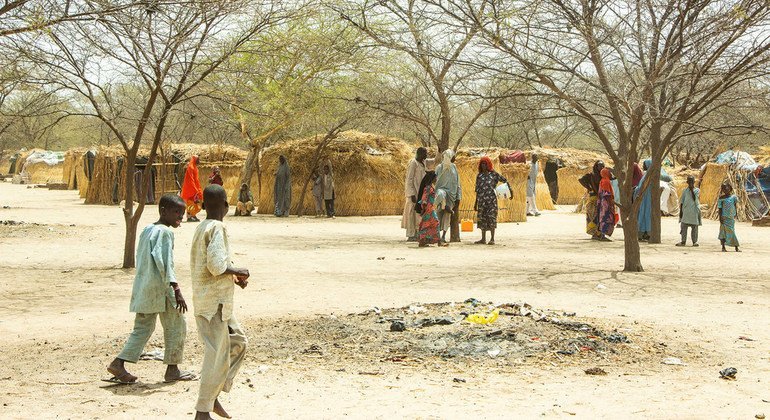
BAOBAB for Women’s Human Rights has called on the Federal Government to prioritise displaced women in climate policies, warning that insecurity, displacement and environmental shocks are worsening their vulnerability across Nigeria’s North-East.
The organisation made the call in a statement issued on Wednesday, November 18, to mark Gender Day at the 2026 United Nations Climate Change Conference (COP31) in Antalya, Türkiye.
The Executive Director of BAOBAB for Women’s Human Rights, Yèyé Bunmi Dipo-Salami, said the effects of climate change and insecurity were interconnected, with women and girls in conflict-affected communities bearing a disproportionate share of the consequences.
She explained that shrinking water sources, failed harvests and competition over land were contributing to tensions and conflicts, which often forced families to abandon their homes and livelihoods.
According to her, displacement further exposes women to economic hardship, insecurity, gender-based violence and limited access to essential services, while increasing their responsibilities for caring for children and other family members.
Dipo-Salami said BAOBAB’s experience working with women in Borno, Adamawa, Taraba and Bauchi over the past three decades had demonstrated how insecurity and displacement undermine women’s livelihoods, safety and participation in decisions affecting their communities.
She recalled that the organisation conducted research in Borno, Jigawa and Zamfara in 2021, with support from the Open Society Initiative for West Africa, to examine how insecurity and displacement affect women’s lives.
Although the research was not specifically designed as a climate study, she said its findings highlighted the vulnerability of displaced women to different forms of shocks, particularly their limited access to income, protection and essential services.
The BAOBAB executive director also expressed concern over the disproportionate impact of climate change on African women, despite the continent contributing less than four per cent of global greenhouse gas emissions.
She cited women’s limited representation in climate decision-making, noting that at COP29, women accounted for approximately one-third of African delegates, while men constituted the majority in 53 of the continent’s 54 delegations.
Dipo-Salami said Nigeria already had important legal and policy frameworks for addressing gender inequality and climate change, including its National Action Plan on Gender and Climate Change adopted in 2020 and the Climate Change Act of 2021.
She also referenced Nigeria’s commitment to the Maputo Protocol, particularly Article 18, which recognises women’s right to a healthy and sustainable environment, as well as Articles 10 and 11, which address women’s right to peace and protection during armed conflict.
However, she argued that the major challenge remained the implementation of these commitments and ensuring that their benefits reached women living in displacement and conflict-affected communities.
The organisation consequently urged the Federal Government to review and renew the National Action Plan on Gender and Climate Change, whose 2020–2025 implementation period has ended, with displaced women specifically recognised as a priority group.
It also called for climate financing, including resources linked to the Belém Gender Action Plan, to reach women-led organisations directly, arguing that such groups often provide immediate support to vulnerable communities but receive limited funding.
The organisation further urged the government to ensure that displaced women participate meaningfully in national climate adaptation planning and peacebuilding processes.
Looking ahead to the next African-hosted climate negotiations in Addis Ababa, Ethiopia, Dipo-Salami said the proposed COP32 conference should be judged by its ability to deliver practical benefits to communities most affected by climate change.
She added that young African feminists under the Kaira Feminist Lab, through the Pan-African Feminist Solidarity Network, were already mobilising in their respective countries to demand the full implementation of the Maputo Protocol, including provisions protecting women’s environmental rights.
She maintained that Nigerian women, particularly those affected by conflict and displacement in the North-East, must have a stronger voice in climate discussions and decisions that directly affect their survival, security and livelihoods.