
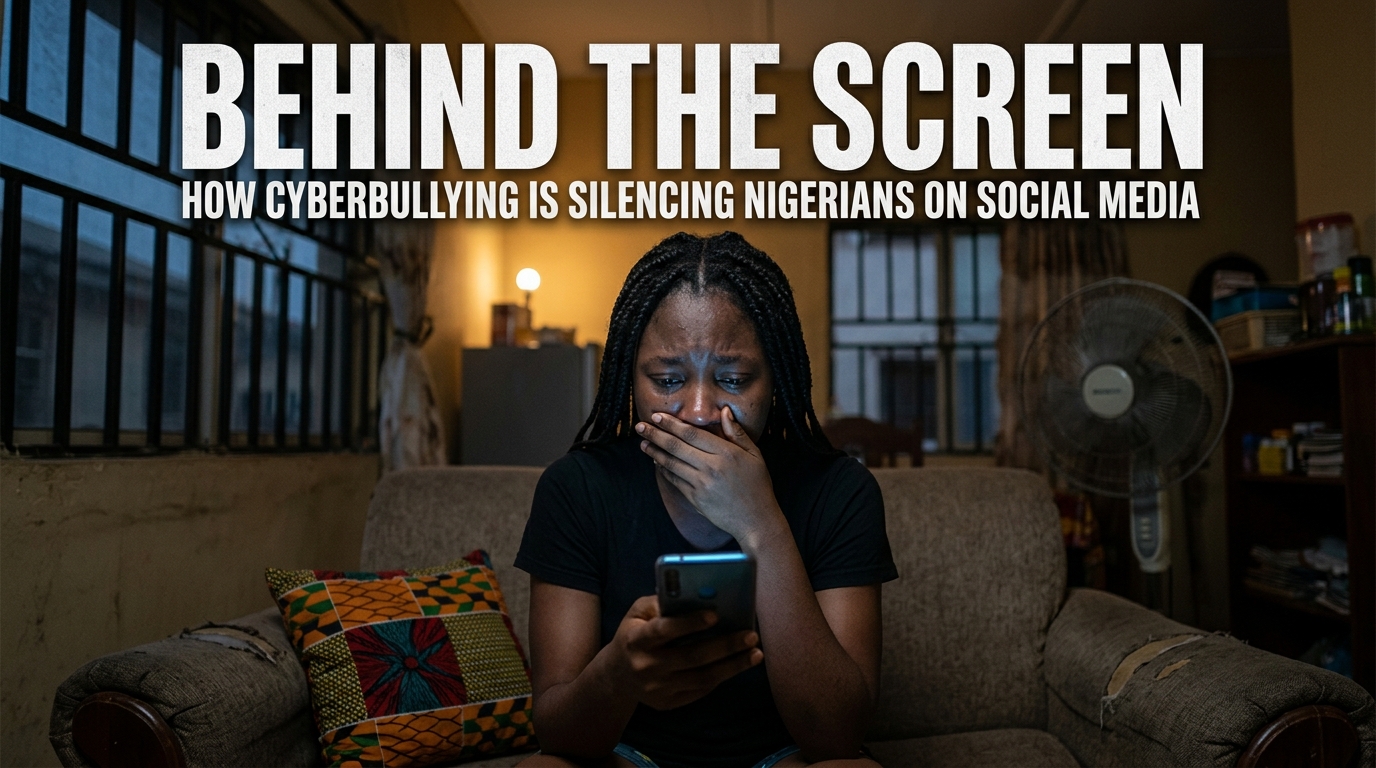
Dataphyte, through its Mini Grant, is supporting this report to promote responsible use of social media spaces among young Nigerians and shed light on the challenges and risks they face online.
The growing use of social media in Nigeria has created unprecedented opportunities for communication, activism, business and public participation. But behind the convenience of Facebook, TikTok, WhatsApp, Instagram and X lies a darker reality: thousands of users are increasingly exposed to insults, humiliation, threats, harassment, impersonation and other forms of online abuse.
The problem is particularly visible among people who use social media to discuss controversial issues, challenge social norms or participate in public debate. In Northern Nigeria, women, journalists, activists and influencers who speak publicly about gender, religion, culture and social change have increasingly reported abusive reactions to their posts. A 2026 News Agency of Nigeria report documented cases involving Northern women who received insulting, sexually degrading and threatening comments after expressing views on women’s rights and marriage. In one case, a social-media user reportedly offered N50,000 for information that could reveal a woman’s telephone number or home address.
The incidents reveal that cyberbullying in Nigeria is no longer limited to schoolchildren exchanging insults online. It has developed into a broader form of digital harassment in which victims can be publicly humiliated, threatened, sexually abused, impersonated or subjected to coordinated attacks across multiple platforms. Earlier reporting on female social-media users in Northern Nigeria documented similar experiences, including the creation of multiple accounts to spread false information about a woman and intense online backlash against women involved in social activism.
When speaking online becomes a punishment
For many women in Northern Nigeria, the abuse appears to become particularly intense when their opinions are perceived as challenging established expectations about women’s behaviour. Research published in 2025 on TikTok influencers in parts of Northern Nigeria found that highly confrontational and emotional online exchanges included personal attacks against social-media users, institutions and women. The study described social media as a space where questions of identity, morality, gender and power are contested through emotionally charged language.
The language in which the abuse occurs presents another largely unexplored dimension of the problem. Much of Nigeria’s online conversation in the North takes place in Hausa, yet the ability of digital platforms to understand and moderate abusive Hausa-language content remains a concern. Cybersecurity experts cited by NAN said harassment in Northern Nigeria frequently occurs in Hausa and coded local expressions, creating difficulties for moderation systems that have historically been developed around languages with much larger digital datasets.
This creates a potential moderation gap. An abusive statement that appears obvious to a Hausa-speaking human moderator may be difficult for an automated system to interpret when it contains slang, cultural references, sarcasm, code-switching or deliberately altered spellings. The Nigerian Communications Commission, however, has recognised the importance of local-language online safety education and provides child-online-protection materials in Hausa, alongside Yoruba, Igbo and Pidgin.
Women and journalists among those exposed
Female journalists are also facing the consequences of online abuse. A 2025 investigation by Dataphyte documented experiences of female journalists in Northern Nigeria who described receiving harassment, including unsolicited obscene material and other forms of online abuse. The report found that many victims chose not to report the incidents, leaving the harassment largely unchallenged.
The consequences can extend beyond the screen. Online abuse can affect a victim’s reputation, emotional wellbeing, professional life and willingness to participate in public discussions. For women in conservative communities, an attack may also move beyond the individual to involve family, marriage, religion and perceived morality. This makes online harassment potentially more damaging because the victim may fear not only what strangers say online, but also how relatives, colleagues and members of the wider community will interpret the accusations.
Nigeria’s legal framework provides avenues for addressing some forms of harmful online conduct. The Cybercrime Act contains provisions on cyberstalking and communications that are persistently offensive, menacing or knowingly false and intended to cause annoyance, inconvenience or anxiety. Other forms of online abuse may also fall under different legal provisions depending on the circumstances.
Yet the existence of legislation does not automatically mean that victims will obtain justice. Many victims do not know where to report online harassment, while others fear that reporting the abuse will expose them to further humiliation. There are also practical difficulties in identifying anonymous perpetrators, preserving digital evidence and persuading platforms to remove harmful material.
The problem is therefore larger than individual insults posted under a Facebook or TikTok video. Social-media abuse can become a cycle in which one person’s post is captured, reposted, circulated through WhatsApp groups, turned into another video and eventually reaches thousands of people. Even when the original post is deleted, copies may continue circulating.
For Northern Nigeria, the issue deserves particular attention because social media has become an important arena for political discussion, religious debate, journalism, entertainment and conversations about changing social norms. The increasing participation of young people and women in these conversations means that the digital space is becoming an extension of public life. When abuse forces people to withdraw from that space, cyberbullying becomes more than a personal problem. It can affect who feels able to speak, what issues can be discussed and whose voices are heard.
Civil-society organisations have begun responding to the problem. In June 2026, the Centre for Information Technology and Development trained young women in Northern Nigeria on digital rights, cybersecurity and prevention of online abuse through its Bauchi Feminist Internet School. CITAD said the initiative was designed to strengthen women’s participation in the digital space and address gender disparities in access and digital rights.
But significant questions remain unanswered. How many Nigerians experience cyberbullying each year? How much of it occurs in Hausa? Which platforms receive the largest number of complaints? How often do platforms remove abusive Hausa-language content? How many victims report to the police? How many cases result in prosecution? And how many victims simply leave social media because they can no longer tolerate the abuse?
These questions point to a wider evidence gap. Nigeria has laws, digital-rights organisations and online-safety initiatives, but there is still limited publicly available, nationally representative data showing the full scale of cyberbullying, particularly in Northern Nigeria and in Hausa-language social-media spaces.
As more Nigerians move their conversations, businesses, activism and relationships online, the distinction between the digital world and everyday life is becoming increasingly blurred. A threat made online can have consequences offline; a rumour posted on Facebook can reach a victim’s family within minutes; and an insulting TikTok video can remain available long after its creator has moved on.
The challenge facing Nigeria is therefore not simply how to teach people to “ignore trolls”. It is how to build digital spaces where citizens can participate without being subjected to intimidation, humiliation and threats, while ensuring that legitimate criticism and freedom of expression are not confused with harassment.
For Northern Nigeria, that conversation must also take place in Hausa. Until the scale of Hausa-language cyberbullying is properly measured, victims documented and the effectiveness of platform moderation independently examined, a significant part of Nigeria’s online abuse problem may remain hidden behind the screen.
This report is supported by the Dataphyte Mini Grant awarded to support reporting on the responsible use of social media spaces among young Nigerians.