
Buhari Abba
For millions of Nigerians living with disabilities, the country’s rapid digital transformation has not necessarily translated into equal access to education, employment, business opportunities and public services.
High costs of smartphones and assistive technologies, inaccessible government websites, limited digital skills and inadequate representation of persons with disabilities (PWDs) in national digital policies continue to widen the gap.
A recent digital inclusion report by the Joint National Association of Persons with Disabilities (JONAPWD) estimates that about 35 million persons with disabilities face severe digital exclusion in Nigeria.
The report identifies the high cost of smart devices and specialised computer tools, gaps in the National Digital Literacy Framework, inaccessible online infrastructure and uneven implementation of disability legislation as some of the major barriers.
Only 23 of Nigeria’s 36 states have adopted the Discrimination Against Persons with Disabilities Act, according to the report.
But for people such as Mustapha Mansur Ashafa, access to appropriate training and technology is beginning to change what is possible.

Mr Ashafa, who is visually impaired, said he never imagined that he could learn to operate a computer until he encountered the Persons with Disabilities (PWDs) Digital Training Hub established by the Centre for Information Technology and Development (CITAD) in Kano.
“I don’t even know people with visually impaired can learn how to use computer. But with CITAD PWDs Digital Lab I learn how to use computer and I have digital literacy knowledge,” he said.
“Before, I don’t know how to use MS Word, Excel, but now I know. Now I enrolled on online course, which is online marketing.”
His experience captures the central objective of the hub, which marked its second anniversary on Monday, August 24, 2026.
How the hub began
CITAD established the PWDs Digital Training Hub on August 24, 2024, with support from the MacArthur Foundation, to promote digital inclusion and equal access to information technology among marginalised communities, particularly persons with disabilities.

The centre was established at a time when education, employment, commerce, communication and access to public services were increasingly moving online.
At the official opening of the facility two years ago, CITAD Executive Director, Yunusa Zakari Ya’u, explained why the organisation considered the intervention necessary.
“We looked around most of our primary and secondary schools do not have facilities to train PWDs. That is why we set up the lab to train them and enable them cascade the knowledge to younger generation,” Mr Ya’u said at the launch.
He said the United Nations had declared that no one should be left behind digitally, adding that the migration of education and other services to online platforms had made digital inclusion increasingly urgent.
According to him, the establishment of the hub was also intended to encourage other organisations to invest in programmes that promote inclusion.
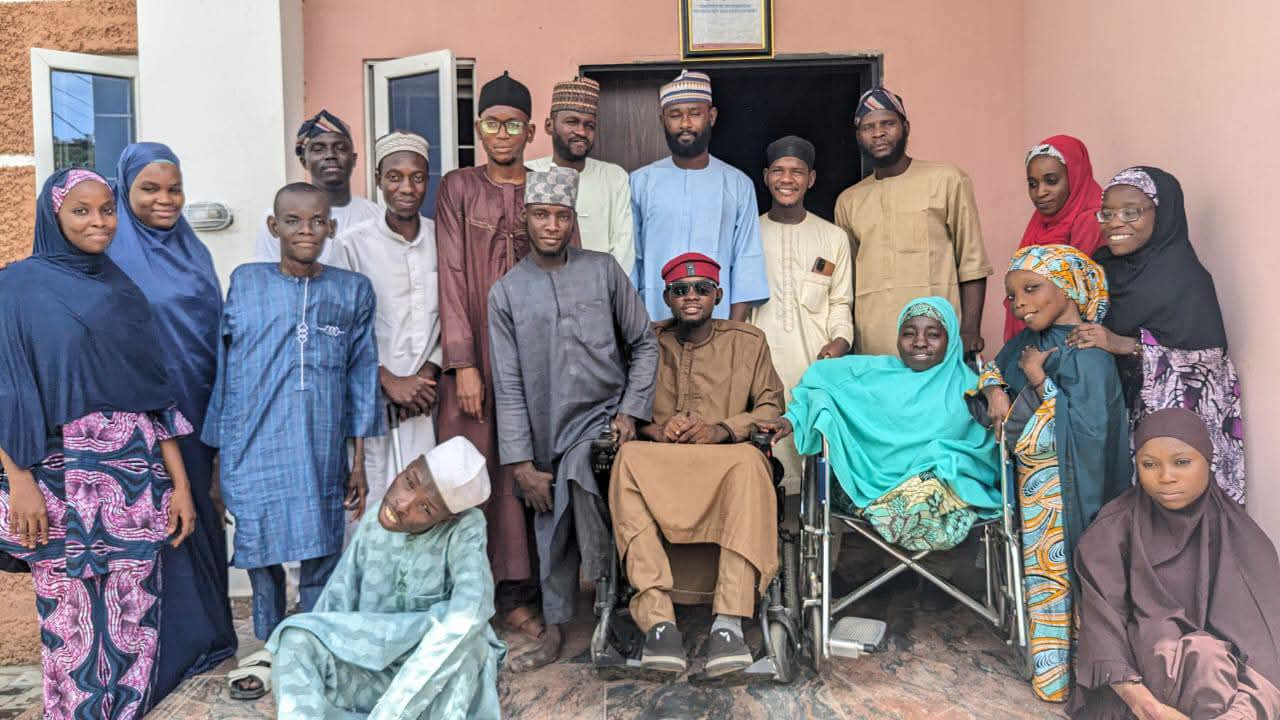
Two years after its establishment, CITAD says the initiative has moved beyond its pilot phase, reaching thousands of persons with disabilities through digital skills training, capacity building, advocacy and accessibility interventions.
Hamza Aminu Fagge, CITAD’s PWDs coordinator, said the hub had trained more than 2,000 persons with disabilities in various information technology skills.

“The PWD Digital Training Hub celebrates the two-year anniversary today, Monday, 24th August 2026,” Mr Fagge said.
He said the centre was equipped with devices designed to respond to the needs of people across different disability clusters.
Among the equipment available at the centre are computers with special keyboards, stereo sound systems, Non-Visual Desktop Access (NVDA), Perkins Braille machines, portable typing machines, IC digital voice recorders, talking calculators, magnification devices and special wheelchairs for mobility support.
The centre has also provided capacity-building training to organisations representing persons with disabilities, including the Skill Acquisition Institute for PWDs, the Association of PWD Journalists and groups representing persons with albinism.

It has conducted training-of-trainers for staff of the Special Education School in Tudun Maliki, supported the establishment of the Kano State Association of People with Dwarfism and carried out audits of government websites to assess their accessibility.
‘Now we create and promote our stories’
The impact of the hub is perhaps most visible in the experiences of beneficiaries who have taken their skills beyond the classroom.
Bashir Aliyu Sheka, a broadcast journalist with a physical disability working with Vision FM in Kano, said the hub helped a group of journalists with special needs acquire digital journalism skills and establish an online platform.

“I received free training from CITAD Digital Training Hub,” Mr Sheka said.
He said CITAD also trained members of Journalists with Special Needs in basic digital journalism, including the use of Canva and graphic design.
“Now we create a page, name it One Life Initiative, and we promote and propagate our stories and other relevant stories,” he said.
According to him, the group has about 15 members who have acquired digital journalism knowledge and skills through the initiative.
For Mr Sheka, the significance of the training extends beyond learning to operate digital tools.
It has given persons with disabilities an opportunity to create content, tell their own stories and participate more actively in the digital public space instead of depending on others to represent them.
Building a community for people with dwarfism
The hub’s impact has also extended to groups that have historically faced social exclusion.
Rukayya Salisu, secretary of the Kano State Association of People with Dwarfism, said CITAD helped bring people with dwarfism together while providing them with basic digital skills.

“CITAD is the only organisation in Kano State that united us and trained us on basic digital skills,” she said.
According to Ms Salisu, the group initially had about eight members but has since grown to between 25 and 30.
She said CITAD also organised a workshop on inclusion for people with dwarfism.
“Since then, any programme for government or otherwise, people with dwarfism are included,” she said.
Her experience illustrates an aspect of digital inclusion that goes beyond access to computers.
For communities that have traditionally struggled for recognition, digital skills can provide tools for organisation, advocacy and greater visibility.
From digital skills to economic opportunities
CITAD says some beneficiaries have gone on to establish online businesses, become financially independent and secure employment.
Mr Fagge cited beneficiaries from different disability clusters, including people with albinism and visually impaired persons, who he said had secured employment with the Kano State Government.
He identified Saudat Bello Hussaini from the albinism cluster and Mustapha Mansir Ashafa, who is visually impaired, among beneficiaries whose experiences demonstrate the potential impact of digital inclusion.

The hub has also recently trained more than 500 young men and women with disabilities on privacy protection and online safety.
The focus has become increasingly important as more persons with disabilities gain access to digital platforms.

Digital participation without knowledge of online safety can expose new users to fraud, privacy violations, harassment and other risks.
For CITAD, therefore, digital inclusion is not only about connecting people to technology. It also involves equipping them with the knowledge and skills to use that technology safely.
A national problem
Despite the progress recorded by initiatives such as the CITAD hub, Nigeria’s wider digital inclusion challenge remains significant.
The JONAPWD report identifies the high cost of assistive technologies as one of the major obstacles confronting persons with disabilities.
A computer or smartphone that may be relatively affordable to an ordinary user can become considerably more expensive when specialised software or hardware is required.
For visually impaired users, screen readers, Braille devices, magnification tools and other assistive technologies can determine whether a digital platform is usable.
Yet many government portals, computer-based tests and social registration systems remain poorly compatible with screen readers and other assistive technologies.
As a result, even when persons with disabilities acquire digital skills, they can still encounter barriers when trying to access essential public services.
The policy environment also presents challenges.
The JONAPWD report says the National Digital Literacy Framework does not sufficiently address the specific needs of persons with disabilities, while the uneven adoption of the Discrimination Against Persons with Disabilities Act across states further complicates efforts to achieve nationwide inclusion.
‘We have to start from somewhere’
The need to address the digital exclusion of persons with disabilities was also recognised by the MacArthur Foundation, which supported the establishment of the CITAD hub.
Kole Ahmed Shettima, director of MacArthur Foundation Nigeria, made the remarks during the official opening of the CITAD PWDs Digital Training Hub on August 24, 2024.
Mr Shettima said persons with disabilities needed sound education to enable them to contribute to Nigeria’s socio-economic development.
He estimated Nigeria’s population of persons with disabilities at between 30 million and 40 million.
“With a population of 30-40 million PWDs in Nigeria, if they are left behind it means that those that will move the nation forward are not knowledgeable, so we have to start from somewhere,” Mr Shettima said at the opening ceremony.
He said the world had become a global village and that persons with disabilities needed the knowledge and skills required to become self-reliant.
Two years later, the concern expressed at the opening remains central to Nigeria’s digital inclusion debate.
The issue has become more urgent as the country’s economy and public services become increasingly dependent on digital platforms.
From applying for jobs and accessing education to registering for government programmes, conducting businesses and communicating with public institutions, digital competence is rapidly becoming a prerequisite for full participation in society.
For persons with disabilities, however, acquiring digital competence is not enough if the systems they are expected to use remain inaccessible.
What comes next?
The experience of the CITAD hub demonstrates how targeted interventions can produce tangible changes in the lives of persons with disabilities.
But the scale of Nigeria’s digital exclusion means that initiatives such as the hub cannot substitute for broader systemic reforms.
Disability advocates have consistently called on government institutions to make digital platforms accessible by design rather than treating accessibility as an afterthought.
This includes ensuring that government websites and online services work with screen readers and other assistive technologies, providing accessible computer-based testing systems and incorporating disability-specific provisions into digital literacy programmes.
It also requires reducing the cost of assistive devices and ensuring consistent implementation of disability legislation across the country.
For CITAD, the work at the PWDs Digital Training Hub is therefore about more than marking two years of operation.
It is also an indication of what becomes possible when persons with disabilities have access to appropriate tools, training and opportunities.
For Mr Ashafa, the change is personal. He has moved from believing that visually impaired people might not be able to learn computer skills to enrolling in an online course in digital marketing.
For Mr Sheka, digital training has helped journalists with special needs tell their own stories.
For Ms Salisu, the training has helped transform a small group of people with dwarfism into a growing community with greater visibility and participation.
For CITAD, the experience of the past two years reinforces a broader lesson: digital inclusion must mean more than providing access to technology.
It must ensure that people who have historically been excluded can acquire the skills, tools and confidence to use technology for education, employment, enterprise, advocacy and participation in public life.
As Nigeria moves deeper into a digital economy, the question is no longer whether persons with disabilities should be included.
The more urgent question is whether the country’s digital systems are being designed in a way that allows them to participate equally.