
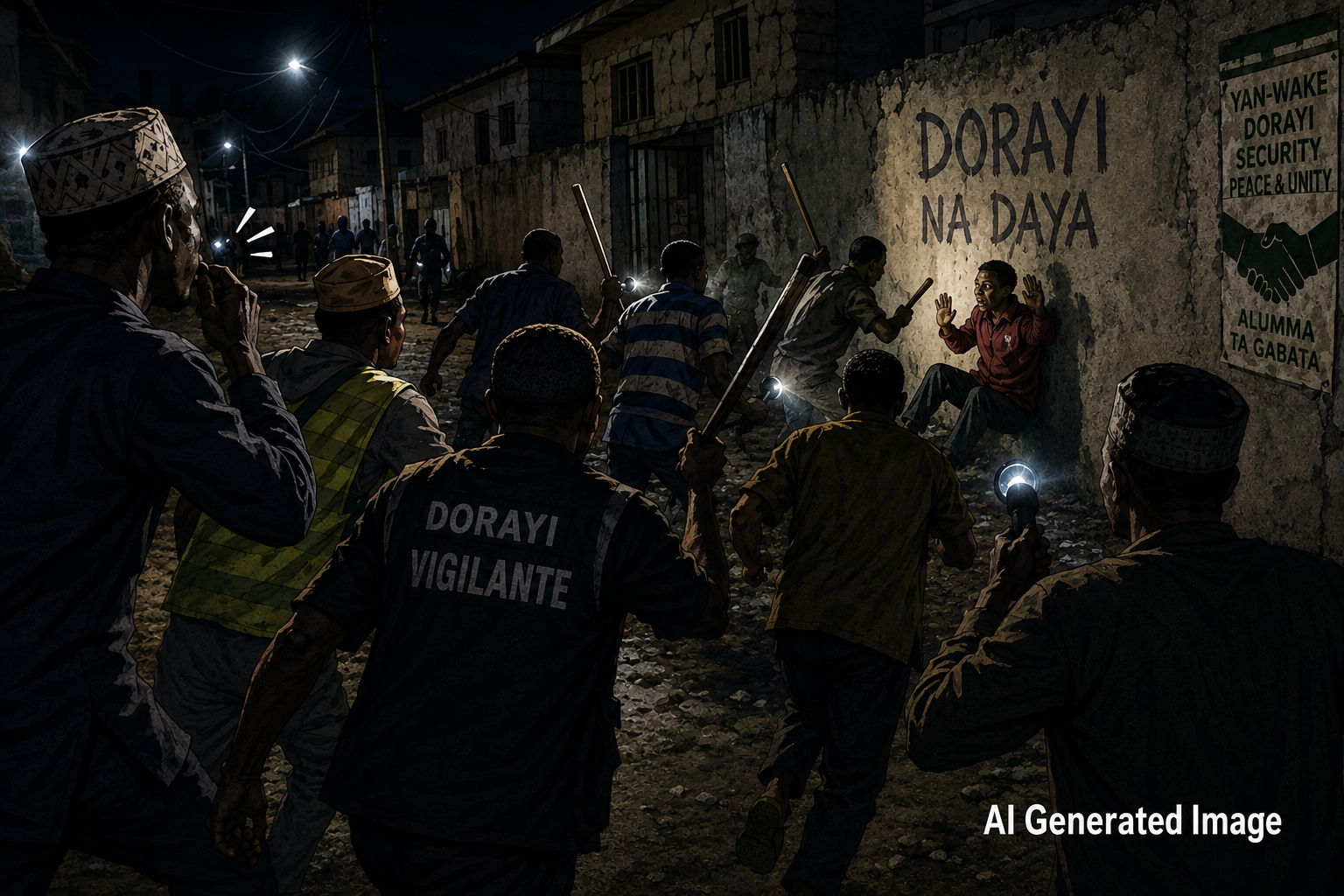
The whistle pierces the night. Then come the hurried footsteps, the shuffle of sticks against pavement, and the glow of flashlights cutting through the darkness. In Dorayi, one of Kano’s most crowded neighbourhoods, a suspected phone thief has been cornered. Before the police arrive, the vigilantes are already in control.
For residents leaning on doorframes, it is a familiar ritual. “If something happens at midnight, we don’t wait for the police,” says a community elder. “We call the vigilantes.”
Across Kano metropolis, from Sabon Gari to Sheka, these community watch groups alongside the Kano State Hisbah Corps have become the unheralded custodians of everyday security. They mediate family quarrels, recover stolen goods, patrol alleys, and even help identify criminal hideouts. Their presence is woven into the rhythm of the city. Yet their rise also raises unsettling questions: where does protection end, and where does unchecked power begin?
A City That Learned to Protect Itself
Kano’s reliance on community security is not new. Long before Hisbah became a household name, residents had devised their own systems of vigilance. Hunters, Yan Sintiri patrols, and volunteers worked with ward heads and clerics to keep watch over markets and streets.
As the city’s population ballooned in the 1980s and 1990s, crime grew more sophisticated, and these informal networks became indispensable. The introduction of Sharia law in 2000 accelerated the shift. By 2003, the Kano State Government formally established the Hisbah Board, institutionalising what had once been grassroots protection.
Today, thousands of Hisbah officers operate alongside vigilantes and newly expanded community watch corps. Their rise reflects a stark reality: Kano has grown faster than its police force. For many residents, waiting for official intervention is simply not an option.
Unlike conventional policing, vigilantes rarely begin with arrests. Their strength lies in intimacy. They know which teenagers have dropped out of school, which families are feuding, where drugs are sold, and which alleys turn dangerous after dusk.
That knowledge has allowed conflicts to be defused before they ignite. In 2025 alone, Hisbah officials reported handling over 12,000 public complaints, resolving nearly 2,000 disputes through reconciliation, and counselling more than 93,000 people on family matters. Thousands of cases were later handed to the police after initial intervention.

Studies link active vigilante groups to reductions in petty crime and juvenile delinquency. Joint patrols with police have improved intelligence against Yan Daba — gangs notorious for street violence and political unrest. For many residents, this collaboration has restored confidence where formal policing faltered.
The Thin Line Between Protection and Control
But peace without accountability can breed its own dangers. Human rights organisations have documented allegations of beatings, unlawful detention, and intimidation by some vigilante groups. Critics warn that organisations meant to complement state security sometimes overstep their mandate, enforcing morality in ways that disproportionately affect the vulnerable.
“The challenge is not community policing itself,” notes one security researcher. “The challenge is ensuring those exercising authority are also subject to the law.” Without oversight, even well-intentioned initiatives risk eroding public trust.
The creation of the Neighbourhood Watch Corps is partly a response to these concerns. By formalising community vigilance under state oversight, Kano hopes to reduce abuses while preserving the benefits of grassroots protection.
Those two Daily Trust stories add an important dimension that is currently missing from your feature: the vigilantes themselves are also victims of violence. They risk their lives, suffer life-changing injuries, and often receive little support after making sacrifices for their communities. This strengthens the balance of your story by showing that the burden of community security comes at a heavy personal cost.
I would insert the following section immediately after “The Thin Line Between Protection and Control” and before “When Politics Enters the Street.”
The Cost of Wearing the Whistle
While public debate often focuses on the powers wielded by vigilantes, far less attention is paid to the dangers they face themselves. Every night, many patrol neighbourhoods armed with little more than whistles, sticks and flashlights, confronting armed criminals without the protection or equipment available to conventional security agencies. Some never make it home.
In June 2024, Mukhtar Garba Baballiya, a respected vigilante leader in Ja’en, Gwale Local Government Area, was stabbed to death while trying to separate rival groups of thugs during a late-night confrontation. What began as an attempt to prevent violence ended with the loss of the man many residents relied on for protection.
Others survive, but with scars that last a lifetime.
One Kano vigilante commander was left permanently disabled after thugs chopped off one of his hands during an operation. Despite years spent protecting his community, his story later became one of abandonment, highlighting the limited welfare, medical care and compensation available to many volunteers once they are injured in the line of duty. His experience reflects a broader reality facing community security operatives who often risk everything with little institutional support.

These tragedies expose another side of Kano’s grassroots security architecture. Vigilantes are expected to confront violent gangs, mediate dangerous disputes and respond before formal security agencies arrive, yet many do so without insurance, adequate protective equipment or guaranteed support for their families if they are killed or incapacitated.
For many residents, they are the first line of defence. But for the vigilantes themselves, every whistle in the night carries the possibility that they may not return home.
When Politics Enters the Street
The risks become most visible during elections. Youth groups originally formed for protection have been accused of morphing into political militias. Known locally as Yan Daba, they have been linked to electoral clashes, property destruction, and attacks on opponents.
The controversy over an Independent Hisbah Fisabilillahi in 2025 underscored these fears. The state government eventually banned the initiative, warning that parallel vigilante organisations could destabilise public order. Analysts say the episode revealed how easily community security can be politicised when safeguards are weak.
Experts agree on one point: vigilantes can manage insecurity, but they cannot erase its causes. Youth unemployment, drug abuse, poverty, and fragile institutions continue to feed Kano’s criminal networks. Unless these structural issues are addressed, communities will keep producing recruits faster than vigilantes can contain them.
Peacebuilders argue that sustainable security must blend community policing with education, job creation, rehabilitation, and stronger justice systems. Patrols may stop today’s crime; opportunity prevents tomorrow’s.
Kano’s vigilantes embody the paradox of grassroots security. They have protected neighbourhoods abandoned by overstretched police, reconciled families, and reduced everyday crime. Yet they also remind us that power without accountability can itself become a source of insecurity.

Their story is not one of heroes or villains. It is the story of a city improvising protection while searching for institutions strong enough, trusted enough, and accountable enough to make vigilantes unnecessary.
Until that day arrives, the whistle echoing through Kano’s streets will remain more than a call to chase criminals. It will be the sound of a community carrying a burden many believe should never have been theirs to bear.
Report by Salim Sani Shehu, edited by Buhari Abba