
ABUJA, Nigeria – As artificial intelligence transforms the global information landscape and sophisticated disinformation campaigns become increasingly difficult to detect, journalists, fact-checkers, and media development experts have called for greater investment in digital verification, cross-border collaboration, and multilingual fact-checking to protect the integrity of elections.
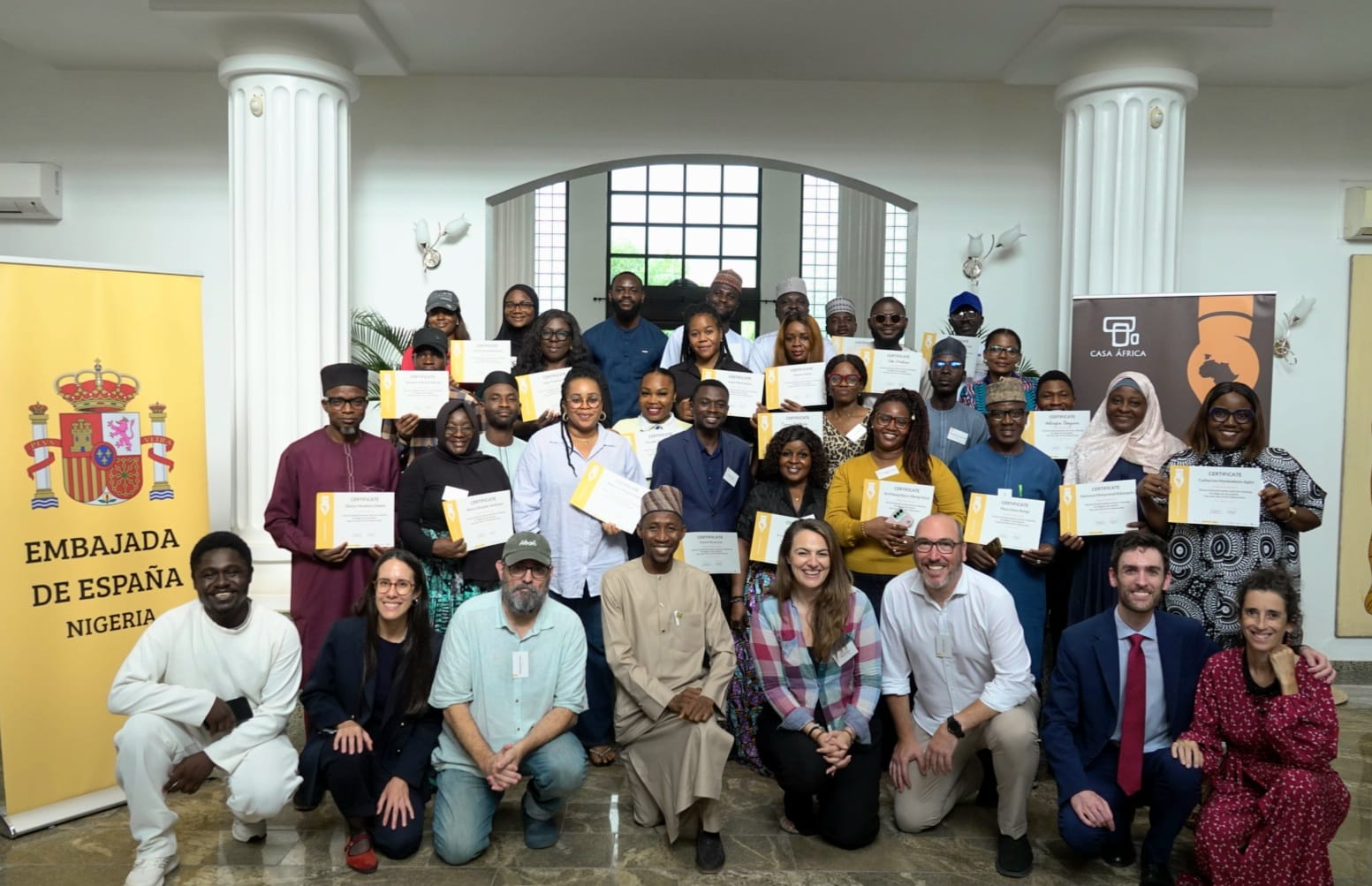
The call came during a two-day intensive training on Electoral Disinformation and Fact-Checking for Nigerian Journalists, held on July 9 and 10, 2026, at the Embassy of Spain in Abuja. The programme was jointly organised by Casa África and the Embassy of Spain in Nigeria, in collaboration with the Centre for Journalism Innovation and Development (CJID), Maldita.es, EFE Verifica, Alkalanci, and the European Union.
The training brought together journalists from different parts of Nigeria to examine the growing threats posed by misinformation, disinformation, foreign information manipulation, and AI-generated content ahead of future elections. Participants also received practical training on digital verification techniques, fact-checking methodologies, and the responsible use of artificial intelligence in journalism.
Opening the programme, Maria Higón Velasco, Chargé d’Affaires at the Embassy of Spain in Nigeria, reaffirmed Spain’s commitment to strengthening democratic institutions and supporting initiatives that promote access to credible and verified information.
She noted that safeguarding democracy requires strong partnerships among governments, journalists, civil society organisations, and international institutions, particularly at a time when false information can spread across digital platforms within minutes.
Welcoming participants, Joan Tusell, Head of Media Relations and Director of Programmes at Casa África, described disinformation as one of the greatest threats facing democracies worldwide.
According to him, electoral misinformation has evolved beyond isolated false claims into organised campaigns capable of influencing public opinion, weakening trust in democratic institutions, and creating divisions within societies. He stressed that international cooperation remains essential in developing effective responses to these challenges.
The first technical session, delivered by Raquel Godos of EFE Verifica, explored the global evolution of electoral disinformation and the growing sophistication of coordinated online influence campaigns.
She explained how social media algorithms often amplify sensational and misleading content faster than verified information, allowing false narratives to reach millions of users before corrections can be issued.
Drawing examples from different regions of the world, Godos warned that electoral disinformation is no longer confined to emerging democracies but has become a global phenomenon capable of undermining public confidence in electoral processes regardless of a country’s level of development.
Turning attention to Nigeria, Silas Jonathan of Dubawa examined the country’s unique information ecosystem and the challenges of combating false narratives across diverse linguistic and cultural communities.
He observed that misinformation frequently spreads through local languages, informal communication channels, and encrypted messaging applications, making detection and verification significantly more difficult.
Jonathan argued that effective fact-checking must move beyond national media organisations and become rooted within communities through local partnerships and indigenous language initiatives that enable citizens to distinguish facts from falsehoods.
Another key session focused on Foreign Information Manipulation and Interference, commonly known as FIMI.
Speaking on the subject, Sébastien Babaud explained how foreign actors increasingly exploit digital platforms to manipulate political conversations, interfere in democratic processes, and influence public opinion in countries across Africa.
He urged governments, media organisations, technology companies, and civil society groups to strengthen regional cooperation and develop coordinated strategies capable of identifying and countering organised disinformation campaigns before they gain momentum.
Practical newsroom skills formed a major component of the training.
Leading participants through modern verification techniques, Stéphane M. Grueso of Maldita.es demonstrated how journalists can use reverse image searches, geolocation, metadata analysis, open-source intelligence, and collaborative verification networks to investigate suspicious digital content.
He also introduced participants to AI-assisted newsroom tools designed to improve efficiency in verification and investigative reporting while reminding journalists that technology should support professional judgement rather than replace it.
Returning to the podium, Raquel Godos examined the emergence of deepfakes and synthetic media, describing them as some of the most serious challenges confronting journalism today.
She noted that advances in artificial intelligence now make it possible to generate highly convincing fake videos, photographs, and audio recordings capable of misleading audiences and influencing political discourse.
According to her, the speed at which false information spreads makes rapid verification systems and stronger international collaboration among fact-checking organisations more important than ever.
The importance of reaching audiences in indigenous languages was highlighted by Alhassan Bala of Alkalanci.
He argued that misinformation often spreads fastest in local languages because fact-checking resources remain limited outside English-language media.
Bala encouraged media organisations to invest in multilingual verification initiatives to ensure that accurate information reaches communities that are often overlooked in national conversations.
The training concluded with an extensive discussion on artificial intelligence and its implications for journalism.
In the final session, Masur Hussain of the Centre for Journalism Innovation and Development (CJID) explored the opportunities and risks presented by rapidly advancing AI technologies.
He explained that while artificial intelligence has become an important tool for improving newsroom productivity and investigative reporting, it has also introduced new threats through the creation of realistic deepfakes and other forms of synthetic media capable of distorting electoral narratives.
Hussain urged journalists to continuously improve their digital verification skills and encouraged newsrooms to establish clear editorial guidelines governing the ethical use of AI.
Throughout the two-day programme, participants engaged in practical exercises designed to strengthen their ability to detect manipulated content, verify digital evidence, investigate online claims, and respond quickly to coordinated disinformation campaigns.
By the end of the training, participants agreed that protecting the credibility of future elections will require more than technological innovation. It will depend on professional journalism, stronger collaboration among fact-checkers, sustained media literacy efforts, and a shared commitment to ensuring that citizens have access to accurate, verified, and trustworthy information in an increasingly complex digital age.
Report by Salim Sani Shehu, edited by Buhari Abba