
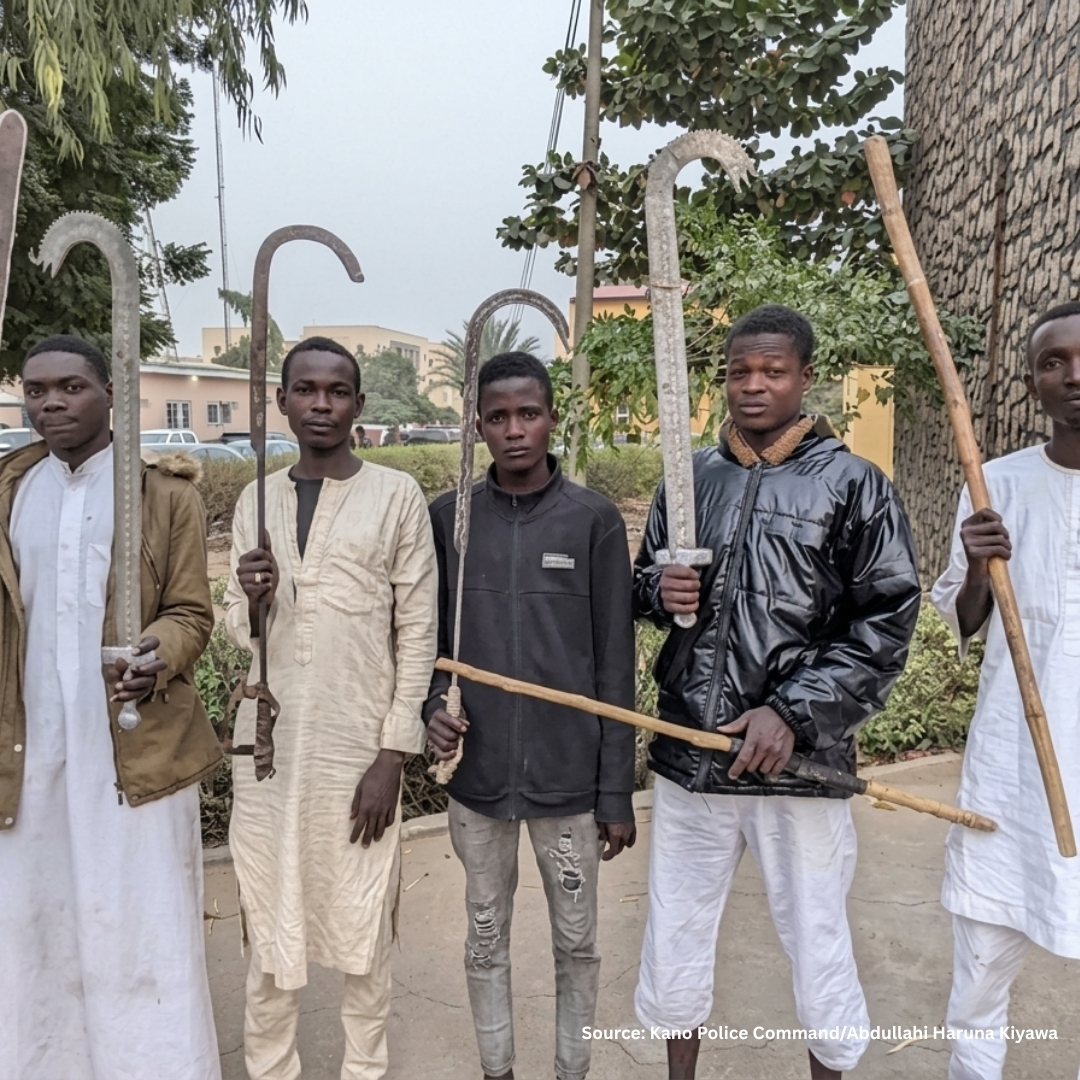
As political activities gradually gather momentum ahead of Nigeria’s 2027 general elections, a quiet but troubling pattern is emerging across parts of Kano State.
Beneath the bustling commercial life, crowded markets and vibrant political culture that have long defined Nigeria’s most populous northern state lies a complex web of gang (thug) violence, drug abuse, youth unemployment, and political mobilization factors that security experts warn could create conditions for future electoral violence if left unaddressed.
An investigation using conflict data, security reports, open-source intelligence (OSINT), election violence records and geospatial analysis reveals that many of the communities that have experienced recurring criminal violence over the years are the same locations where political tensions have historically escalated during election periods.
The findings raise critical questions about whether Kano is adequately prepared to prevent a repeat of past violence as political competition intensifies ahead of 2027.

Satellite map of Kano showing municipal areas Source: Google Map/Salim
A State Living With Persistent Violence
Although Kano is often viewed as one of Nigeria’s relatively stable states, available conflict and security data tell a more complicated story.
Analysis of election conflict incidents recorded by security monitoring organisations shows that violence has remained a recurring challenge across several parts of the state. While large-scale insurgency has not affected Kano in the same way it has impacted parts of the North-East, residents continue to grapple with gang clashes, armed robbery, political violence, communal disputes and other forms of insecurity.
Data from the Nigeria Risk Index indicate that Kano recorded dozens of security incidents in recent years, with drug trafficking and substance abuse emerging as one of the state’s most significant security challenges.
The data further identify parts of metropolitan Kano as areas experiencing higher concentrations of reported incidents. Conflict experts say such trends deserve close attention because criminal violence rarely exists in isolation. Instead, they argue, it often intersects with broader social and political dynamics.
“Violence is rarely random,” said a security analyst who has studied conflict patterns in Northern Nigeria for more than a decade.
“It usually follows identifiable patterns linked to poverty, social exclusion, weak governance, organised criminality and political competition.”
The Shadow of Yan Daba
At the centre of Kano’s security concerns are the activities of youth gangs popularly known as Yan Daba. For years, residents across communities in Dala, Fagge, Gwale, Kano Municipal, Nasarawa and other urban centres have complained about gangs involved in street fights, intimidation, extortion, theft, phone snatching and violent clashes.
Community leaders from some of the areas which are persistance with the occur of the incident say the phenomenon has evolved significantly over the years. What once consisted largely of loosely organised groups of unemployed youths has gradually transformed into more organised networks operating across neighbourhoods.
Residents interviewed in several communities described incidents in which rival gangs fought openly in public spaces, sometimes using dangerous weapons and leaving behind injuries and property damage.
In some areas, parents say they fear allowing their children to move around after dark because of concerns about gang activities.

Map of Kano Metropolis showing places where incidents occurred during past elections Source: GIS Desk/Salim
While security agencies have carried out periodic crackdowns, many residents argue that the underlying drivers of gang activity remain largely unresolved.
Youth unemployment, school dropout rates, poverty, substance abuse and limited economic opportunities continue to create conditions that make recruitment into gangs attractive for some young people.
Drug Abuse and the Violence Connection
Perhaps the most significant finding from available security assessments is the growing role of drug abuse in Kano’s security landscape.
Data from the Nigeria Risk Index identify drug trafficking and substance abuse as the leading security concern in the state.
Security officials, rehabilitation experts and community leaders consistently point to drug abuse as one of the primary factors fuelling gang violence.
The relationship is evident across multiple communities where residents describe a cycle in which substance abuse contributes to criminal behaviour, while criminal networks simultaneously facilitate access to drugs. Anti-drug campaigners say many gang members are first introduced to criminal networks through drug-related activities. Once recruited, they often become involved in theft, violent confrontations and political mobilisation.
 Drug Abuse Hotspots and Violence Incidents In the Municpal Area Source: GIS Desk/Salim
For conflict analysts, this relationship represents an important warning sign.
Research conducted across different parts of Nigeria has repeatedly shown that communities experiencing high levels of substance abuse often face elevated risks of criminal violence and social instability.
When Criminal Networks Meet Politics
The most controversial aspect of Kano’s violence landscape concerns allegations that some youth gangs become politically useful during election periods. For decades, observers have documented the use of political thugs by rival political actors across Nigeria.
These groups are often accused of intimidating opponents, disrupting campaigns, mobilising crowds and influencing political activities.
In Kano, concerns about the relationship between gangs and politics have resurfaced following recent reports of increasing gang violence.
Amnesty International recently announced investigations into incidents involving violent gangs and political violence in parts of Kano, highlighting allegations that some gangs may have political connections.
Although direct evidence linking specific politicians to criminal groups remains difficult to establish, security experts say the overlap between gang activity and political mobilisation deserves closer scrutiny.
“The question is not whether political thuggery exists,” said a political analyst in Kano.
“The question is how these networks are organised, who funds them and how they are activated during election periods.”
Lessons From Tudun Wada
The strongest example of how political tensions can escalate into deadly violence remains the events that unfolded in Tudun Wada Local Government Area during the 2023 general elections.
The violence that erupted during the collation of election results left multiple people dead and several others injured. Properties were destroyed, political offices were attacked and entire communities were plunged into fear.

Accounts from residents described scenes of chaos as armed groups allegedly targeted opponents and attacked properties. The violence eventually prompted intervention by electoral authorities and security agencies.
For many observers, the events served as a stark reminder that electoral violence remains a serious threat in Kano despite efforts to strengthen democratic institutions.
The Geography of Electoral Risk
To understand whether similar violence could occur again, this investigation examined patterns of conflict incidents, gang activity, drug abuse, population density and historical election violence.
Using Geographic Information Systems (GIS), multiple datasets were layered to identify areas where these risk factors overlap. The analysis reveals that certain communities consistently appear across different categories of violence. Several locations recorded repeated incidents involving gangs, criminal violence, drug abuse and political tensions. In conflict prevention, these overlapping factors are often described as “risk multipliers” because they increase the likelihood of future instability.

Violence Risk Overlay Analysis Source: GIS Desk/Salim
The findings suggest that violence in Kano should not be viewed as isolated incidents occurring independently of one another. Rather, they form part of a broader ecosystem shaped by social, economic and political realities.
What Social Media Reveals
The rise of social media has created new opportunities for monitoring emerging security threats. An analysis of online activity across platforms such as Facebook, TikTok, X and Telegram reveals how gangs and politically aligned youth groups increasingly use digital platforms to communicate, recruit supporters and project influence.
The Accountability Problem
Despite recurring episodes of violence across Kano over the years, successful investigations and prosecutions have remained relatively limited, raising concerns about the effectiveness of the state’s justice system in addressing politically and criminally motivated violence.
Civil society organisations and human rights advocates argue that the absence of consistent accountability has fostered a culture of impunity, where perpetrators perceive little risk of facing legal consequences for acts of violence. They contend that this failure not only denies justice to victims but also emboldens individuals and groups to engage in future acts of violence with minimal fear of prosecution.
Looking Ahead to 2027
Here’s a more concise, formal, and impactful version suitable for the conclusion of an investigative report.
As Kano moves toward the 2027 general elections, security experts, election observers and community leaders are urging authorities to act early to prevent violence. They recommend strengthening youth empowerment initiatives, expanding anti-drug interventions, improving intelligence gathering, enhancing community policing and closely monitoring signs of emerging tensions.
The findings of this investigation suggest that many of the warning indicators associated with previous outbreaks of violence remain visible in several communities. Experts caution that addressing these risks before they escalate will be critical to ensuring peaceful elections and preventing a repeat of past violence.
Salim Sani Shehu report, edited by Buhari Abba.