
Buhari Abba
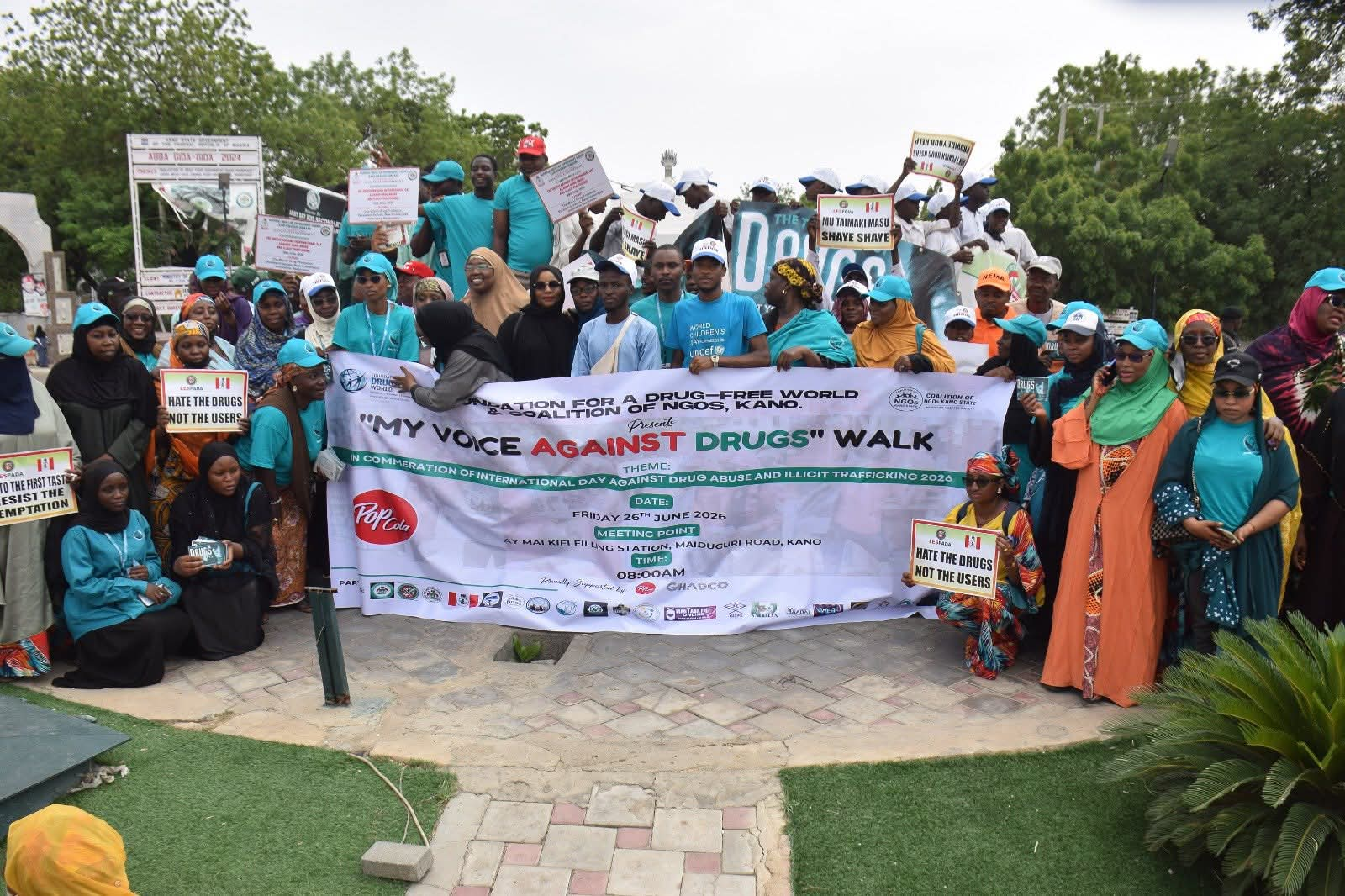
The Coalition of NGOs Against Drug Abuse (CONADA), in collaboration with the Kano State chapter of the Nigeria Association of Women Journalists (NAWOJ), on Friday organised a road walk in Kano to commemorate the 2026 International Day Against Drug Abuse and Illicit Trafficking.
The awareness walk, led by the Executive Director of the League for Societal Protection Against Drug Abuse (LESPADA), Maryam Hassan, began from Maiduguri Road and ended at the Kano State Government House.
The event attracted journalists, civil society organisations, youth groups, government agencies and anti-drug campaigners, who called for stronger collaboration to address the growing challenge of substance abuse.
Among the participating organisations were NAWOJ, Kano State chapter; LESPADA; NACCRAN; YOSPIS; Widi-Jalo Foundation; YAADAI; IYECF; TAFTA; Jam’iyyar Matan Arewa; Visionary Women for Empowerment and Humanitarian Foundation (VWEHF); Martaba FM; Premier Radio; the Kano State Government; the National Emergency Management Agency (NEMA); Kurmawa Reformatory Centre; the Kano State Emergency Management Agency (SEMA); and the Kano State Watershed, Erosion and Climate Change Management Agency (WADA), among others.
Speaking on the sidelines of the event, Ms Hassan described the rising rate of drug abuse among young people as a major concern requiring the commitment of government, families and communities.
“The prevalence of substance abuse among our youths is becoming increasingly worrisome. It is a challenge that demands coordinated efforts from all stakeholders if we are to secure the future of our society,” she said.
She commended Kano State Governor Abba Kabir Yusuf for constituting the Special Task Force on Drug Abuse and Illicit Trafficking, describing the initiative as a significant step towards tackling the problem.
Ms Hassan also praised the governor for appointing two CONADA members—herself and Maryam RD Muhammad—to serve on the committee.
“The inclusion of women journalists in the task force acknowledges the vital role the media plays in creating public awareness and mobilising communities against drug abuse,” she said.
She urged parents, religious leaders, schools, traditional institutions and relevant government agencies to intensify efforts to prevent substance abuse and support the rehabilitation of people affected by drug addiction.
“No single institution can address this challenge alone. We all have responsibilities in protecting our young people from the harmful effects of illicit drugs,” she added.
According to her, sustained public enlightenment campaigns, youth empowerment programmes and community engagement remain critical to reducing drug abuse across the country.
The International Day Against Drug Abuse and Illicit Trafficking is observed annually on 26 June to promote global action and cooperation towards achieving a drug-free society.
The day was established by the United Nations in 1987 to strengthen international efforts against drug abuse and illicit trafficking.