
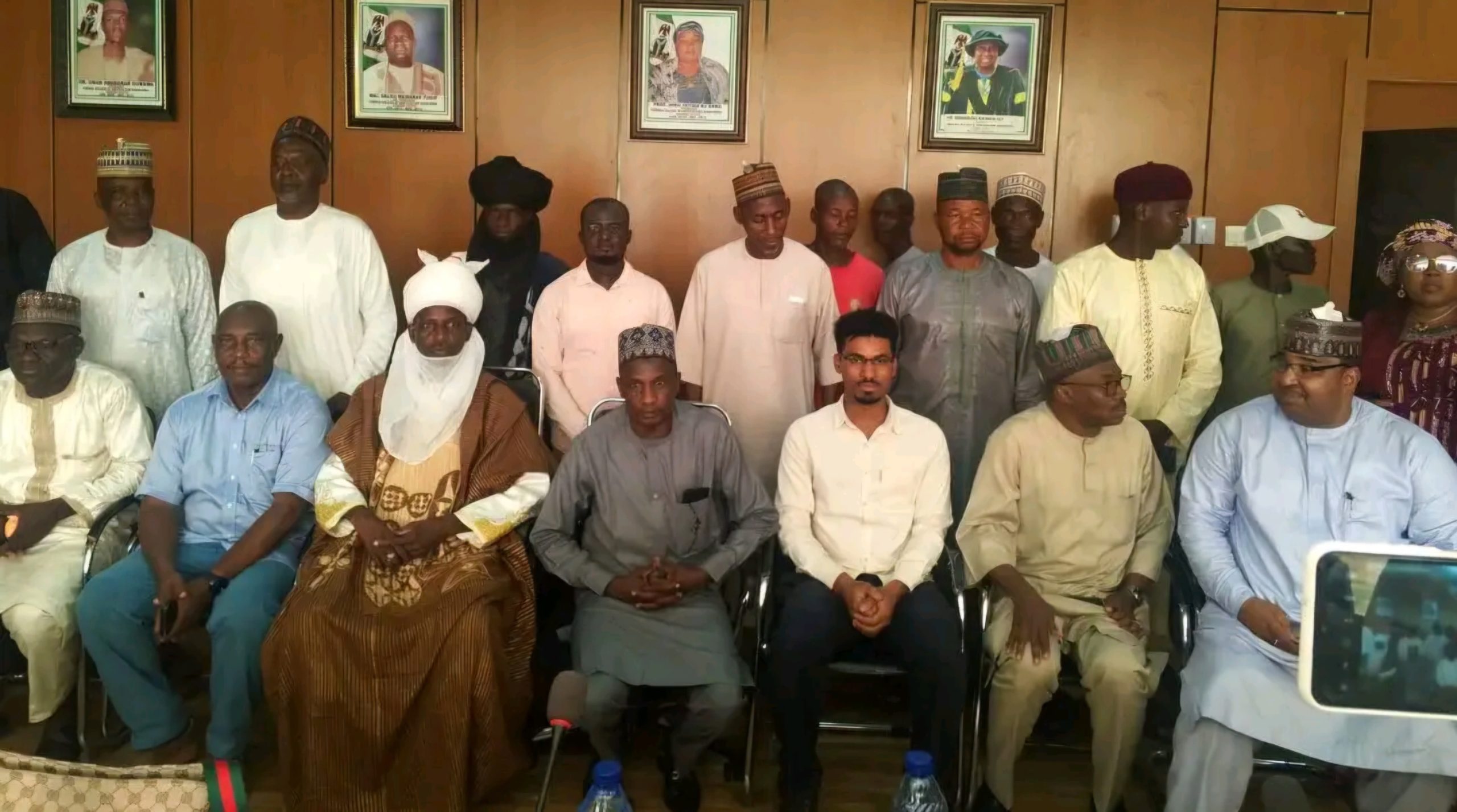
By Aliyu Gerengi, Gombe
The Upper Benue River Basin Development Authority (UBRBDA), Daɗinkowa Area Office, in collaboration with the Centre for Climate-Smart Agriculture at Cosmopolitan University, Abuja, has trained farmers in Gombe State on climate-smart agricultural practices aimed at improving productivity and enhancing food security.
The training, which lasted two days, brought together farmers from different communities to learn modern farming techniques designed to increase yields while reducing dependence on land and water resources.
Speaking during the workshop, the Chief Scientific Officer of the Centre for Climate-Smart Agriculture, Professor Badaru Yahaya Usman, said climate-smart agriculture offers farmers the opportunity to achieve significantly higher yields with fewer resources.
“In climate-smart agriculture, you can harvest crop yield in a single hectare of land equivalent to what is harvested on ten hectares under conventional farming methods,” Mr Usman said.
He explained that the approach enables farmers to cope with challenges associated with climate change, including water scarcity and poor soil moisture retention, through the application of scientific farming methods and innovative irrigation systems.
According to him, the centre plans to support participating farmers with access to smart borehole loans to facilitate all-season farming.
“These boreholes can reach water depths of up to 300 metres and come with remote monitoring capabilities. We are also offering a 10-year warranty on the equipment and will undertake repairs for any damage that is not deliberate,” he said.
Mr Usman added that the centre employs geospatial technology to analyse soil composition remotely, enabling farmers to make informed decisions on crop selection and planting strategies.
The Area Manager of UBRBDA Daɗinkowa Office, Abubakar Muhammad Bello, said the training was organised to ensure farmers understand emerging agricultural technologies before benefiting from institutional interventions and loan schemes.
“Our target is for you to cultivate one hectare of land using climate-smart agriculture and obtain what is currently achieved on ten hectares under non-climate-smart agriculture,” Mr Bello told participants.
He urged farmers to take advantage of scientific innovations that are making agriculture more productive and profitable.
A participant and experienced farmer, Muhammad Auwal, said his years in agriculture had yielded greater financial returns than his entire career in the civil service.
“My experience in farming has shown me that agriculture can be more rewarding than many other professions when the right methods are applied,” he said.
The Chairman of the Water Users Association, Idris K. Shehu, commended UBRBDA for organising the training and pledged that farmers would embrace the knowledge acquired during the workshop.
“We appreciate the authority for consistently prioritising the welfare and development of farmers. We are committed to adopting these new techniques to improve our productivity,” Mr Shehu said.
Following the workshop, the training team visited the Federal College of Horticulture, Daɗinkowa, to explore areas of collaboration.
The Acting Provost of the institution, Umar Abdullahi Umar, welcomed the initiative and expressed the college’s readiness to partner with the centre in promoting climate-smart agriculture across the region.
He said collaboration between research institutions and farmers would be crucial in addressing the challenges facing agricultural production and ensuring sustainable food systems.