
Ali Sabo & Buhari Abba
Twelve-year-old Amina Musa dreams of becoming a nurse.
The Primary Six pupil at Rano Dawaki Primary School in Kano State says she wants to care for sick people and save lives. But throughout her years in school, she has never seen a library.
“Our teachers tell us to read books, but we don’t have a library in our school,” she said, sitting on the floor of her classroom.

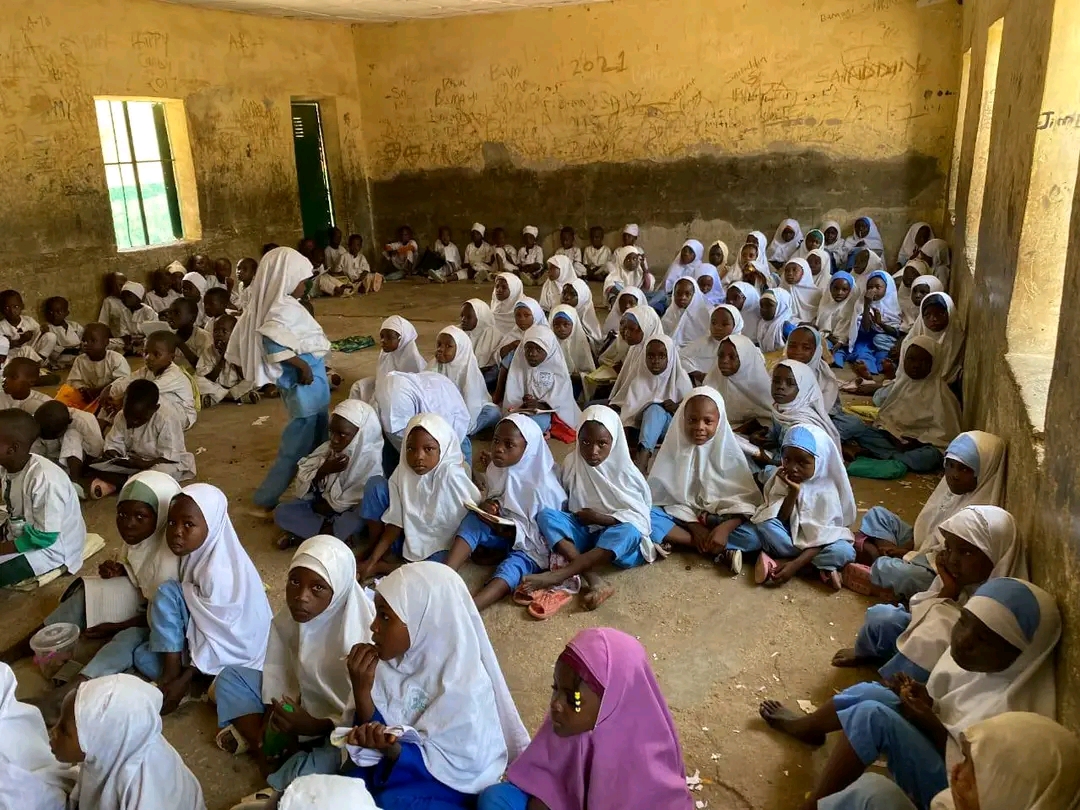
Amina is among hundreds of pupils attending the public primary school in Rano Dawaki, a predominantly Hausa community in Rano Local Government Area, where children learn in overcrowded classrooms, many without desks or chairs.
A visit by CITAD Radio found pupils packed into classrooms with limited furniture, inadequate learning facilities and no library — conditions residents say have persisted for years despite repeated government promises to improve public education.

Founded in 1974, the school has served generations of children in the community. More than five decades later, however, many pupils continue to sit directly on cement floors during lessons.
Children in Early Childhood Care and Development (ECCD) classes through Primary Four have no desks or chairs, according to observations at the school. They sit shoulder-to-shoulder on bare floors, while available classroom space struggles to accommodate growing enrolment.
Although some desks are provided for Primary Five and Six pupils, residents say they are far from sufficient. Several children share the available furniture, while others remain seated on the floor.

“The overcrowding is alarming,” said Ibrahim Lawan, a resident of the community.
“Imagine a teacher trying to teach more than 200 pupils in one classroom. It becomes almost impossible to control the class or ensure that every child understands what is being taught.”
Residents told CITAD Radio that some classrooms accommodate more than 240 pupils at a time, a situation they say undermines effective teaching and learning.
Beyond the shortage of furniture, the school has no library, limiting pupils’ access to reading materials and opportunities to develop literacy skills outside classroom lessons.

Community members say enrolment has increased steadily over the years, but educational facilities have not expanded at the same pace.
“The number of pupils keeps increasing every year, but the facilities remain largely the same,” said Salisu Rano, another resident.
According to residents, the shortage of classrooms has contributed significantly to congestion across the school.
Education specialists have long warned that overcrowded classrooms and inadequate learning facilities can negatively affect academic performance, concentration and pupil retention.

The concerns come as Kano State continues to grapple with one of Nigeria’s largest populations of out-of-school children. UNICEF recently identified Kano among states most affected by the crisis and called for greater investment in foundational education to improve access and learning outcomes.
Residents interviewed by CITAD Radio accused successive governments of neglecting the school despite repeated appeals for intervention.
According to them, the last major improvement to the school came through projects funded by the Japanese government.
“The only major intervention we can remember came through projects funded by the Japanese Government,” Salisu Rano said.
“Since then, there has been very little improvement. The facilities are deteriorating while the population of pupils continues to grow.”
AFP could not independently verify the residents’ claims. However, community members insist that no major government-backed infrastructure project has been undertaken at the school in recent years.
For parents, the situation is becoming increasingly difficult to ignore.
“Our children deserve better,” said Muhammad Sani Muguji, whose three children attend the school.
“How can a child concentrate on learning while sitting on the floor from morning until closing time? Education is important, but children also need a conducive environment for learning.”
Residents are calling on the Kano State Government, the Rano Local Government Council, development partners and philanthropists to provide urgent support.
Their demands include the construction of additional classrooms, the provision of desks and chairs, rehabilitation of existing structures and the establishment of a functional library.
“We are appealing to the government and well-meaning individuals to assist this school,” Rano said.
“If more classrooms are built and basic facilities are provided, pupils will have a better opportunity to learn and fulfil their dreams.”
For Amina, the request is simpler.
“I want our school to have books and chairs,” she said. “It will help us learn better and become successful in the future.”
Until improvements arrive, hundreds of pupils at Rano Dawaki Primary School will continue studying from classroom floors, highlighting the challenges facing public education in Kano, one of Nigeria’s most populous states.