
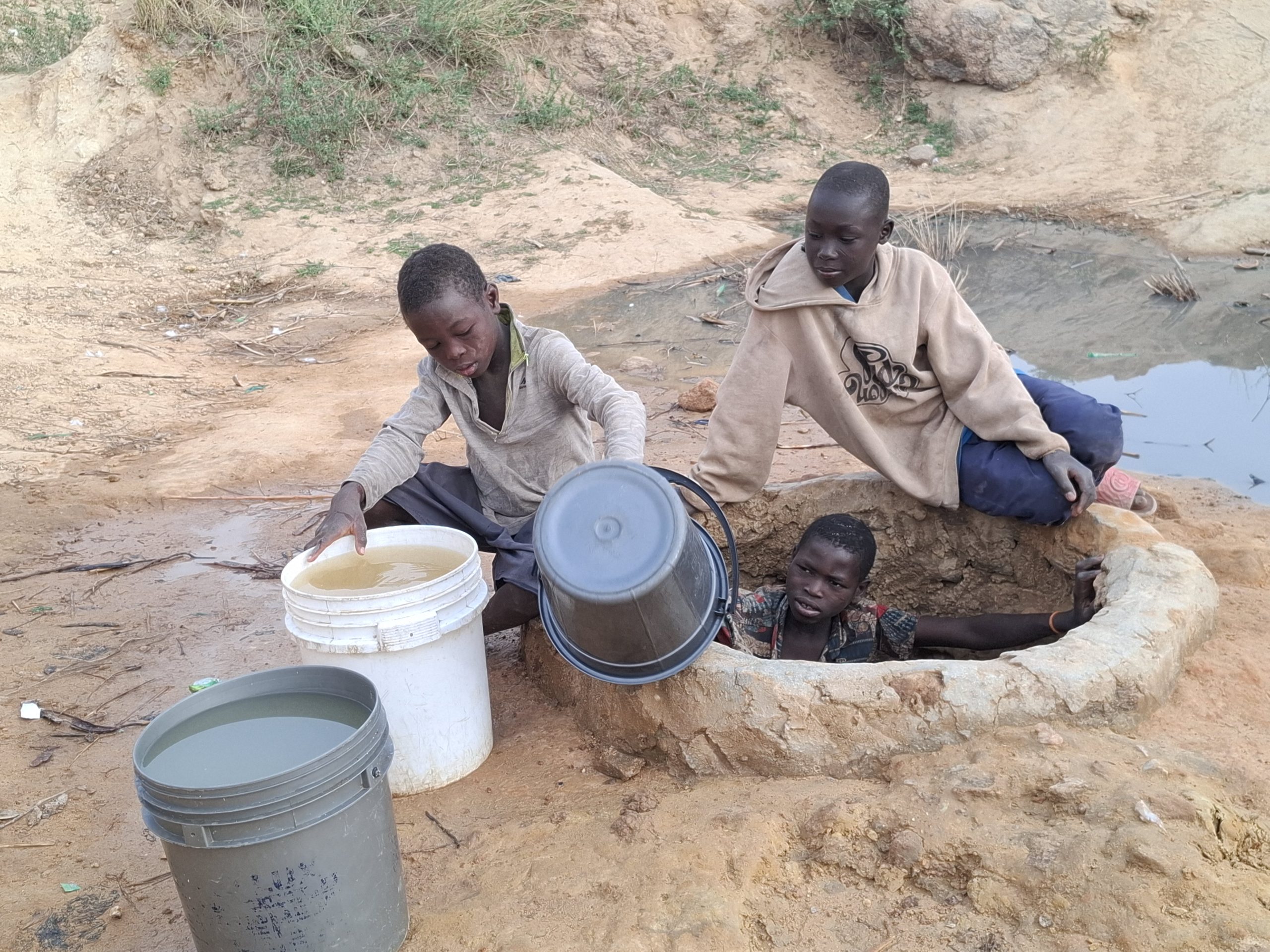
Ali Sabo & Buhari Abba
In the quiet rural community of Rano in Kano State, north-west Nigeria, 13-year-old Aliyu Abdullahi and his 15-year-old brother, Umar Abdullahi, begin each day before sunrise.
By 6 a.m., the boys are already on their bicycle, heading toward a congested water point where dozens of residents queue for hours to fetch what they describe as “survival water” from a shallow, unprotected open wall.

“I wake up very early every day with my brother so that we can get water before it finishes or the queue becomes too long,” Aliyu said, as he stood beside a line of jerrycans stretching across a dusty path. “Sometimes we miss school or arrive late because of this.”
Despite Nigeria’s vast surface and underground water resources, many rural communities like Rano continue to face severe water shortages, exposing residents to preventable diseases and deepening sanitation challenges.
Nigeria is endowed with abundant freshwater systems and is divided into multiple hydrological zones. Yet access to safe drinking water remains uneven, especially in rural and semi-urban settlements where infrastructure is either absent or poorly maintained.
This gap reflects a wider national public health crisis. Poor access to improved water and sanitation in Nigeria remains a major contributing factor to high morbidity and mortality rates among children under five.
The use of contaminated drinking water and poor sanitary conditions increases vulnerability to water-borne diseases, including diarrhoea, which leads to the deaths of more than 70,000 children under five annually.
About 73 per cent of the diarrhoeal and enteric disease burden is linked to poor access to adequate water, sanitation and hygiene (WASH), a burden disproportionately borne by poorer children. Repeated WASH-related illnesses also contribute to school absenteeism and malnutrition. Nationally, only 26.5 per cent of the population use improved drinking water sources and sanitation facilities, while about 22 per cent still practice open defecation.
In a March 2018 report, the United Nations Children’s Fund (UNICEF) warned that access to safe drinking water remains a serious challenge for most Nigerians, especially those in rural areas. It noted that the Multiple Indicator Cluster Survey (MICS) conducted in 2016/17 showed that about 40 per cent of households—representing roughly 69 million people—do not have access to clean water sources.

“In the rural areas, 19 million people walk long distances to collect unsafe water from lakes, streams and rivers,” the UN agency said.
UNICEF further stressed that children without access to safe water are more likely to die in infancy and childhood from waterborne diseases, adding that “diarrhea remains the leading cause of death among children under five years of age in Nigeria.”
Government intervention
In response to the growing water access challenge, the Kano State Government in 2025 approved N3.3 billion for the execution of water supply and energy-related projects aimed at improving access to clean and safe water across the state.

The governor’s spokesperson, Sunusi Bature Dawakin Tofa, disclosed this in a statement, noting that the approvals include the construction of a modern Water Treatment Plant at Taliwaiwai in Rano Local Government Area, as well as payment for electricity and fuel supplies used by the State Water Board to sustain uninterrupted operations across its facilities.
The statement added that Governor Abba Kabir Yusuf remains committed to strengthening essential public utilities and ensuring sustainable water availability for both domestic and industrial consumption.
“This intervention will guarantee steady water supply, improve energy efficiency, and promote better living standards for the people of Kano,” the statement said.
However, in Findi community, also within Rano Local Government Area, residents continue to depend on an open, unprotected wall as their primary water source. The site, surrounded by refuse and exposed to animals, has become a daily gathering point for women, children, and the elderly who have no alternative.
The situation is compounded by the absence of proper Water, Sanitation and Hygiene (WASH) facilities. Open defecation remains common in the community, increasing the risk of contamination of nearby water sources.
Public health expert, Malam Ado Garba, who also speaks on CITAD Radio, warned that the situation reflects a broader rural sanitation emergency that requires urgent government intervention.

“What is happening in communities like Findi is a textbook case of high exposure to waterborne diseases,” he said. “When people rely on unprotected water sources mixed with human and animal waste, outbreaks of cholera, typhoid and diarrhoea are not a question of if, but when.”
He added that without functional WASH infrastructure, health education alone would not be enough to stop recurring infections.
“You cannot tell people to practice hygiene when the environment makes it impossible,” Malam Ado Garba said. “Government at all levels must prioritise safe water supply systems, protect rural water points, and invest in sanitation facilities. Anything less is a continued risk to lives.”
He further noted that children are the most vulnerable in such settings, especially those who combine school attendance with daily water collection.
“When a child spends hours searching for water before going to school, you are not only affecting education, you are also exposing them to disease and long-term health complications,” he said during his CITAD Radio commentary.
A resident, Isyaku Ahmad, who was seen scooping water from the murky wall, described the situation as dangerous but unavoidable.
“We know this water is not clean, but what choice do we have?” he asked. “There is no borehole here. If we don’t fetch from this place, our families will go thirsty.”
Another resident, Aliyu Abdu, said the community had repeatedly appealed for government intervention without success.
“We have been living like this for years. During the rainy season, it becomes worse because dirty water flows into the wall,” he said. “We are afraid of sickness, but we cannot survive without water.”
For Hanne Bello, a mother of four who also depends on the same source, the daily struggle has become a burden she fears may soon have consequences.
“My children fall sick often,” she said quietly while filling her container. “Sometimes it is diarrhoea, sometimes fever. We don’t even know what is causing it, but we suspect the water.”
Health workers have consistently linked poor sanitation and unsafe water consumption to recurring outbreaks of cholera in parts of northern Nigeria. The combination of open defecation, poor drainage, and reliance on unprotected water sources significantly increases community vulnerability.
In Findi, the open wall used for fetching water is visibly contaminated, with stagnant water mixed with waste materials. Residents say there are no protective structures, no treatment systems, and no alternative water supply.
Despite repeated public awareness campaigns on hygiene practices, many rural communities continue to struggle with basic infrastructure deficits.
Back on the queue, Aliyu Abdullahi adjusts his grip on the bicycle handle as his brother Umar watches the growing line behind them. Their concern is not only about time lost to water collection, but also the silent threat they believe is growing in their community.

“We are always afraid of sickness,” Umar said. “But we still have to drink it.”
As Nigeria continues to grapple with water access challenges despite its natural endowment, communities like Findi highlight the widening gap between resource availability and rural infrastructure, leaving thousands to depend on unsafe sources that threaten their health and survival.