
By Sani Saidu Muhammad
CJID AI and Tech Reporting fellow
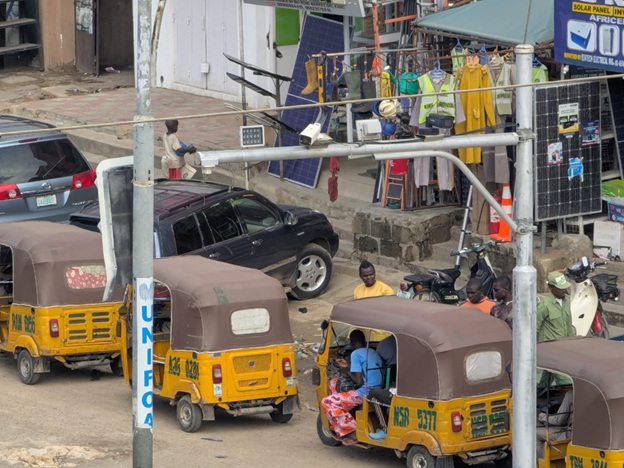
In Kano’s crowded Sabon Gari district, rows of CCTV cameras now track every footstep. “feels like I’m under constant surveillance,” says Mr Itodu of Gunduwawa, a 51-year-old tuk-tuk rider in Sabon Gari, Kano. Itodo recalls a night in 2024 when armed officers pulled him from his bike after a new AI-driven system flagged him as a suspect –– having an uncanny resemblance with someone the team searched for. He says police forced him to disclose his phone password and ID number under pressure.
CCTV installation has exploded: recent data shows that Kano city now has roughly 5,000 surveillance cameras –– almost twice as many as all of Lagos (which has about 2,300). That puts Kano at 1.19 cameras per 1,000 people (versus 0.14 in Lagos) –– a density far above global averages. Residents like Ali were never told about these systems, nor were they offered any form of consent or opt-out. Instead, a tacit bargain has been made: in the name of security, public space has been taken over by silent, unaccountable watchers.
In Kano, the surveillance push can be traced back roughly a decade. In early 2015, just after Boko Haram’s deadly 2014 bombing campaign shook the city, Deputy Governor (and later Governor) Abdullahi Ganduje announced a “scientific approach” to insecurity by installing CCTV cameras in strategic areas. Under Ganduje’s tenure (2015–2023), the state repeatedly sought funds to expand this system: in mid-2022, the Kano Assembly approved a ₦10 billion (~$20 million) loan for city‐wide CCTV. Civil-society activists briefly stalled the loan in court, but a federal judge ultimately lifted the injunction, noting that Kano faced “security challenges based on banditry and kidnapping” that cameras could help counter. Officials argued that, even as “one of the most peaceful states,” Kano still needed high-tech tools to guard against growing crime – from rural bandit raids and kidnappings to urban crimes like the recent wave of street “phone-snatchers’’. This local drive mirrored a national trend: Nigeria is now Africa’s largest buyer of surveillance technology, spending hundreds of millions annually, and past federal projects (e.g. a $470 million CCTV network awarded to China’s ZTE in 2010) show how heavily imported tech has underpinned security plans. “We needed eyes everywhere after those bombings,” recalls a former Kano police Area commander, ASP Hassan Kamal, highlighting how the insurgency and rising banditry pushed officials toward foreign partnerships and cutting-edge “safe city” solutions (often quietly discussed but rarely detailed) to protect the state.

In short, Kano’s surveillance programs began in the mid-2010s as a direct response to insurgency and crime, and have been driven by a steady procurement of advanced camera systems and biometric tech (often via loans or foreign contracts) to fill the state’s security gaps.
Deals, Drones, and Silence: Inside Northern Nigeria’s Secret Surveillance Spending
Key figures underscore the scale of these programs:
The biggest challenge was procurement secrecy deals which were struck quietly. Vendors and contracts are often hidden under National Security exemptions, or bundled into larger “smart city” bids. Official documents and public debate were rare. In both states, the media only learned of these projects when funds were approved or equipment unveiled – often with more fanfare than transparency.

Faces on File: The Price for AI Policing
“Each time an agent says, ‘The machine says you did something.’ They give no details. We end up signing forms that won’t reveal what happened to us.”
The human costs are already emerging. In Kano, 28-year-old Fatima Musa, a college student, says the cameras have become a tool of intimidation: “Last month I was approached by police at a checkpoint. They said my face had been ‘identified by facial-recognition software as a match to a suspicious profile. I asked how – I had done nothing wrong. They took me to the station and questioned me extensively without legal representation” Fatima was released without charge, but left shaken. Across Kaduna, farmers and youths report being stopped arbitrarily. “A drone flew low over my village last harvest season,” recalls Yakubu Suleiman, 47, a small-scale rural farmer near Birnin Gwari. “Soldiers came afterwards and took away my phone, accusing me of hiding something. They never returned it.”

These testimonies align with broader patterns. In 2019 the MIT Media Lab warned that facial-recognition software is dramatically less accurate on dark-skinned Africans –– especially women. In controlled tests, error rates soared to 35% for dark-skinned women (versus <1% for light-skinned men). A U.S. National Institute of Standards and Technology study similarly found that most facial-AI systems work well on white males but are far less reliable on other ethnicities. Victims in Kano and Kaduna worry exactly this: the algorithms were trained on foreign datasets (American or Chinese mugshots) and “don’t recognize our faces correctly,” as Yusuf Babagana, a civil-society technologist put it. Experts say it is only a matter of time before an innocent Black Nigerian is misidentified as a criminal by these machines –– as has already happened abroad. (For example, The Detroit News documented a U.S. Black man who was wrongly arrested after a police facial-AI system falsely matched him to a suspect.)
Beyond racial bias, the legal vacuum is chilling. Until 2023, Nigeria had no comprehensive data-privacy law –– and even the new Nigeria Data Protection Act offers no explicit safeguards against live surveillance. A legal review notes that “there is currently no specific law or regulation that directly regulates AI in Nigeria”. In practice, this means any public camera, street drone or face-recognition scanner can operate unchecked. There are no warrants, no public hearings, and few penalties if data is abused. Citizens have virtually no right to know when or how they are being monitored. Civil libertarians point out that Nigeria’s human-rights and privacy frameworks simply cannot catch up with today’s drones-and-data world. An Abuja-based tech-policy analyst, Abdurrahman Olamide, warns that even a robust Data Protection Act, 2023 –– signed into law on June 12, 2023 –– is years away from being enforced, and contains no detailed limits on state surveillance or facial recognition.
Meanwhile, public accountability is nil. In Kano, local NGOs had to sue just to halt the latest CCTV loan –– an extraordinary step highlighting how procurement rules were ignored. In Kaduna, the contracts for cameras and drones were never presented to the legislature. Instead, funds appeared hidden in the security vote. Attempts to question this secrecy have been brushed aside by numerous security officials invoking “operational secrecy.” In an interview, Barrister Abdurrahim Imam, a human-rights lawyer in Kaduna said, “We keep asking: where did these cameras come from, and who is responsible when they misfire? Nobody will say.”
Compounding the problem, many systems are imported from abroad under opaque arrangements. Official announcements name local “private” partners, but the hardware often turns out to be Chinese or Israeli. Nigeria’s military, for instance, has increasingly bought Chinese CH-4 combat drones for operations in the Northwest. Globally, watchdogs have flagged Dahua and Hikvision –– two giant Chinese camera-makers –– for security holes and close ties to Beijing. Indeed, European intelligence reports have warned that surveillance gear from Beijing “has an extensive catalogue of vulnerabilities to exploit”. That matters if sensors in Kano or Kaduna call home to foreign servers. Yet, till date, the government has shown no concern. Provincial governments and police simply welcome the low bids. As one Kaduna political insider admits (speaking off the record), “When Chinese companies offered these cameras at a fraction of the price, everyone turned a blind eye. Now we’re stuck with them.”
The effects on ordinary citizens are already grim. In Kano’s Sabon Gari Market, 25-year-old Janet Sunday, a street vendor, says her heart sinks whenever cameras swivel her way. “I see a live feed of myself on a screen once in the control room,” she explains. “Sometimes police use it to accuse me of selling control drugs without a license. If I argue, I’m labeled defiant.” Others report being stopped near anything from mosques to street corners. Mallam Musa Jafar, a Kaduna taxi driver, said he has memorized which checkpoints to avoid, because “the cameras notice my car as suspicious even when I’m not doing anything.” These fears are amplified by higher authorities. Kaduna’s governor, Nasir El-Rufai, boasted publicly in 2019 that the CCTV center was “state-of-the-art” and that drones would help “identify bandits in forest reserves”. But government messaging has been two-faced: officials pledge safety and non-interference, even as communities feel increasingly spied on.
Several Kano residents told us they have been stopped under vague “intelligence” pretexts. “I’ve been detained twice,” said Usman, a 29-year-old bus conductor in Kano. “Each time an agent says, ‘The machine says you did something.’ They give no details. We end up signing forms that won’t reveal what happened to us.” No records are kept, so no one knows how many have been pulled aside. In just one neighborhood of Shagari Quarters in Kano, Comrade Muhammad Tukur Liman, a local activist, said at least 10 young men were stopped after cameras in January 2025, nearly all from poor families; half were detained overnight without charge.
In response to criticisms, security officials maintain these tools are for terrorists and kidnappers, not average people. In Kano, the once-booming controller of the new CCTV center –– a former police commissioner –– now refuses media interviews. Certified Information Technology Professional Yusuf Ibrahim Sharada, Special Adviser Digital Economy to Governor Abba Kabir Yusuf said only that “the technology is to aid our security agencies” and that “all operations follow existing laws”, citing counter-terrorism powers. Kaduna’s Internal Security Ministry likewise promises that data feeds go only to vetted intelligence units. But they decline to detail any oversight. When asked how they prevent misuse, one Kaduna officer tersely replied, “By the chain of command.”
Attempts to speak with military and security officials overseeing the project were unsuccessful, as they declined to respond to questions or grant interviews.
Surveillance Expert Raises Red Flags on Bias, Secrecy, and Data Risks
In the absence of official responses, experts warn that Kano’s surveillance infrastructure may be outpacing local safeguards. Dr. Rahila S. Garba, a cybersecurity lecturer at Bayero University Kano and former adviser to Nigeria’s National Information Technology Development Agency (NITDA), says the rapid deployment of facial recognition systems in the city raises serious ethical and operational questions.
“These systems are often trained on datasets from non-African populations,” she explained. “That means they misidentify people, especially dark-skinned women — at far higher rates. There’s evidence of this globally, and now, we’re seeing the same pattern in places like Kano.”
In Garba’s view, this lack of transparency creates real risks: “Facial recognition without data protection laws is a threat to civil liberties. It allows profiling, tracking, even wrongful arrests. The systems are watching people, but no one is watching the system.”
She pointed out that while surveillance may deter crime in theory, it also concentrates power in the hands of those who control the data. “Without laws on how long footage is stored, who accesses it, and how it’s used, residents have no protection if things go wrong.”
Dr. Garba calls for a moratorium on facial recognition until proper testing is done in Nigerian contexts, as well as an open review of all surveillance contracts. “We need homegrown policies, public consultation, and independent oversight. Otherwise, we’re just importing systems that don’t understand us and misread us.”
Not everyone is convinced. International civil-society networks are starting to take note. Last month, a coalition of African digital-rights groups submitted a petition to Nigeria’s National Information Technology Development Agency (NITDA) demanding an audit of all CCTV and drone contracts. They cited global norms like the EU’s GDPR and a new African Union model law on surveillance, arguing Nigeria falls short. Meanwhile, experts here point out that courts have few precedents. In 2018 A Kaduna magistrate quashed a police request for phone records, citing privacy rights in the Constitution. That same judge now questions whether any law could stop an AI system from peering behind a lens.
Academics warn we’re on a slippery slope. “Facial-recognition systems are statistically biased,” notes Dr. Chinyere Okafor, a data-science professor at Bayero University, Kano. “Every algorithm in this surveillance chain was built by someone else’s data and assumptions. For example, the MIT Media Lab found that AI misgendered or misidentified up to 35% of dark-skinned African women. It’s no different in Nigeria –– the machines simply weren’t trained on our diversity.”
In practice, these blind spots can be deadly. Around the world, critics point to wrongful detentions and even police shootings triggered by false biometric matches. A 2019 U.S. study warned that Black men are up to 100 times more likely to be misidentified by unregulated face-AI than white men. Nigeria cannot afford to be the next test case.
The political implications are also stark. Kano’s new governor, Abba Yusuf (elected 2023), has signaled he wants a review of Ganduje-era contracts, but progress has stalled. Kaduna’s governor has praised technological innovation even as violence ebbs, suggesting the cameras and drones are here to stay. Yet local opposition is growing. In Abuja, a cross-party House of Representatives delegation has quietly begun probing northern states’ surveillance deals. The Kano First Forum is planning a Freedom of Information suit to unearth contract details. And Tamila Shvyryda has publicly raised concerns about the risks of “secret policing” with AI in Nigeria. Even Nigeria’s legal profession is waking up: the Bar Association recently issued guidelines urging transparency when lawyers use AI tools.
Globally, Nigeria’s experiment is drawing attention. Human-rights monitors liken the situation to Asia or the Gulf, not democratic Africa. Nigeria’s tech credibility is on the line. If unchecked, the northern deployments could become Africa’s largest real-world test of surveillance AI – with scant consent and accountability. Ultimately, the question remains: who is watching the watchers? The surveillance state was sold as a shield against violence. But to many citizens it feels like an opaque panopticon of state power – a watchful eye without a face, answering to no one.
The evidence gathered so far points to one conclusion: without urgent public debate and legal scrutiny, AI surveillance in Kano and Kaduna is on track to erode basic freedoms. Critics are warning that what started as security support will soon harden into a tool for political control. The time for oversight is now. As Comrade Liman, a Kaduna rights activist put it, “Technology can help keep us safe – but not when it keeps our rulers safe from us.”
– This report was produced with support from the Centre for Journalism Innovation and Development (CJID) and Luminate